
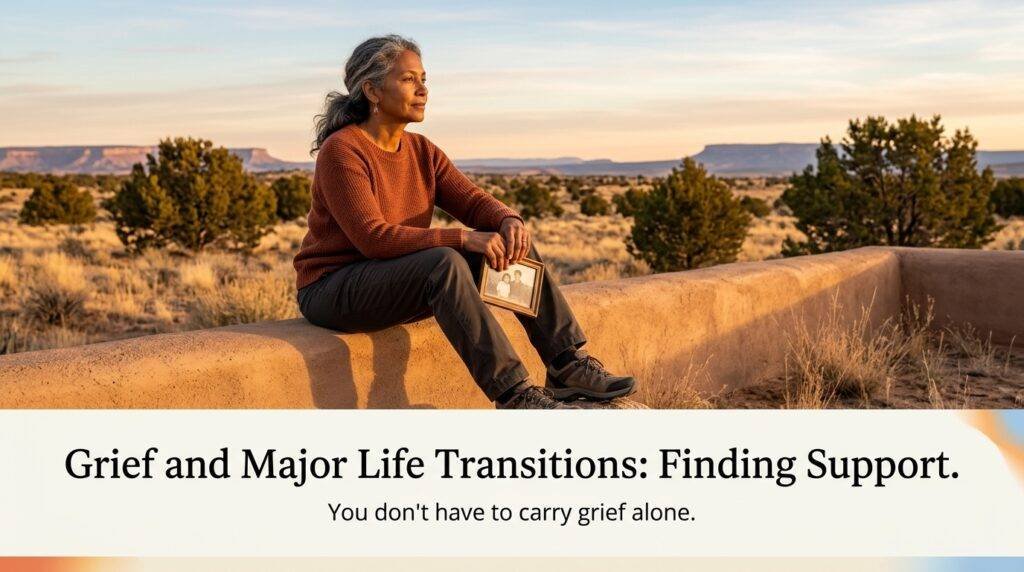
When Life Changes Faster Than You Can Keep Up
Maybe you lost a parent, a spouse, or a close friend. Maybe it was a different kind of loss: a divorce, a job that defined you, a move away from the place you’ve always called home, or children leaving the house. Maybe you’re facing a serious diagnosis or caring for someone whose life is changing. Whatever it is, the ground has shifted, and you’re trying to find your footing. Coping with grief and major life transitions is one of the hardest things people go through, and no one should have to do it entirely alone.
Grief doesn’t follow the neat stages people sometimes describe. It can feel like sadness, but also anger, guilt, relief, numbness, anxiety, or exhaustion, sometimes all in the same day. It can arrive in waves, triggered by a song, a smell, a holiday, or an ordinary Tuesday.
In New Mexico, grief happens across a wide range of communities, cultures, and places, from cities to remote small towns. Many families draw on rich traditions of faith, ceremony, and remembrance. At the same time, many people live far from family, in rural areas where support services are hours away, or in situations where talking about grief openly isn’t easy.
Some people find their way through loss with the support of family, friends, faith, and time. Others find that grief becomes heavier rather than lighter, or that a major life change has stirred up depression, anxiety, or old wounds. Both experiences are human, and both deserve care.
This guide explains what grief can look like, how it differs from depression, when grief may need more support, practical ways to cope, and how New Mexicans can find help, including telehealth care from home. Let’s start with what’s normal.

Understanding Grief and Life Transitions
Grief is the natural response to losing someone or something important. It isn’t a problem to fix, and there’s no right way to do it. Coping with grief means finding ways to carry the loss while gradually rebuilding a life that includes it.
Grief isn’t only about death. People grieve many kinds of losses:
- The death of a loved one, including a pet
- Divorce, separation, or the end of an important relationship
- Job loss, retirement, or a career change
- Moving away from home, community, or family
- A serious diagnosis, disability, or loss of independence
- Children growing up and leaving home
Some grief goes unrecognized. Losses like a miscarriage, the death of an ex-partner, estrangement from family, or the loss of a pet may not receive the same acknowledgment from others. This kind of grief can feel especially lonely.
What grief can feel like. Common experiences include sadness, yearning, waves of tears, anger, guilt, trouble concentrating, poor sleep, changes in appetite, fatigue, and physical aches. Many people also feel moments of relief or even laughter, and that’s normal too.
Grief has no fixed timeline. Many people notice that grief softens over months and years, even though it may never fully disappear. Anniversaries, holidays, and milestones can bring waves of grief long after a loss.
When grief stays intense. For some people, grief remains overwhelming and disabling long after a loss. The American Psychiatric Association recognizes prolonged grief disorder, in which intense yearning or preoccupation with the person who died, along with significant distress, persists and interferes with daily life, generally at least a year after the loss for adults.
Grief after traumatic loss. Sudden, violent, or unexpected deaths, including loss to suicide, can bring trauma symptoms alongside grief, such as intrusive images, avoidance, or feeling constantly on edge. Support specifically for this kind of loss can help.
Only a qualified clinician can diagnose prolonged grief disorder, depression, or another condition.
Grief vs. Depression: How to Tell the Difference
Grief and depression share many features, and they can happen together. Some differences can help you notice when grief may be turning into something more.
Grief often:
- Comes in waves, often triggered by reminders of the loss
- Centers on the person or thing that was lost
- Allows moments of comfort, connection, or even joy
- Leaves your sense of self-worth mostly intact
Depression often:
- Feels constant, heavy, and pervasive, not just tied to reminders
- Brings feelings of worthlessness, emptiness, or excessive guilt
- Makes it hard to enjoy anything, even comforting moments
- Includes hopelessness about the future or thoughts that life isn’t worth living
When both are present. Grief can trigger depression, especially in people with a history of depression or few sources of support. When symptoms of depression appear alongside grief, both deserve attention.
A safety note. Grief can sometimes bring thoughts of wanting to join a loved one or not wanting to go on. If you’re having thoughts of suicide or self-harm, reach out right away by calling or texting 988, calling the New Mexico Crisis and Access Line at 1-855-662-7474, or calling 911.
Why People Struggle to Get Support
Many people carry grief quietly for a long time. Several patterns make it harder to get support.
“I should be over this by now.” People around you may expect grief to fade on a schedule, and you may expect it of yourself. When it doesn’t, you might feel embarrassed to keep talking about it.
Staying strong for others. Parents, caregivers, and those who hold families together often put their own grief aside to care for everyone else.
Life changes don’t feel “big enough.” A retirement or a move may not seem like a reason to grieve, so people dismiss the sadness and disorientation that come with it.
Distance and isolation. In rural parts of New Mexico, grief support groups, counselors, and psychiatric providers may be far away. Families may be spread across the state or the country.
Turning to alcohol or overworking. Numbing pain with alcohol, staying constantly busy, or withdrawing completely can feel like coping but may make grief and depression harder to work through.
Not knowing what kind of help exists. Many people don’t realize that grief support ranges from peer groups and faith communities to therapy and psychiatric care, depending on what’s needed.
[CLINICIAN’S NOTE] Two patterns we see often: believing grief should follow a timeline, and missing depression because it’s hidden inside grief. There’s no correct schedule for grieving, and pressure to “move on” often makes people feel more alone. At the same time, when hopelessness, worthlessness, or an inability to function lasts for weeks, depression may have developed alongside grief. That combination deserves care. Getting help doesn’t mean you’re grieving wrong or forgetting the person or life you lost.
Practical Ways to Cope, and When to Seek Care
There’s no single right way to grieve. These approaches can help many people, and professional care can add support when grief feels too heavy.
Let grief be what it is. Allow yourself to feel what comes, without judging it. Tears, anger, laughter, and numbness can all be part of grief.
Keep basic routines. Regular meals, sleep, and some daily movement give structure during a time when everything else feels unsteady.
Stay connected. Spending time with people who let you talk, or simply sit together, can ease isolation. Peer support groups, in person or online, can connect you with others who understand.
Honor traditions and memories. Faith practices, cultural rituals, visiting a meaningful place, cooking a loved one’s recipe, or creating a memory book can be powerful ways to carry a loss forward.
Be gentle with major decisions. When possible, give yourself time before making big changes, such as moving or selling a home, right after a loss.
Watch for warning signs. Seek professional support if grief is preventing you from functioning, if you’re relying on alcohol or other substances, if you feel hopeless or worthless, or if intense grief isn’t easing at all over time.
Treating depression alongside grief. When depression develops, treatment can include therapy, lifestyle support, and medication when appropriate. Treating depression doesn’t take away grief; it can help you grieve without being crushed by it. Learn more about our approach to depression treatment.
Addressing anxiety during transitions. Major life changes often bring anxiety: worry about the future, finances, health, or being alone. Treatment can help you feel steadier as you adjust. See how we approach anxiety and panic treatment.
Support after traumatic loss. When a loss was sudden or traumatic, trauma-informed care can help with intrusive memories, avoidance, and feeling on edge, at a pace that feels safe. Read about our approach to trauma care.
Grief-focused therapy. Therapies designed for prolonged or complicated grief can help people process the loss, reconnect with life, and find meaning. We can incorporate grief-informed approaches into care or help coordinate a referral.
Looking at the whole person. A comprehensive psychiatric evaluation considers mood, sleep, health, medications, substance use, support, and the losses you’re carrying. Functional and hormonal lab testing may be recommended when symptoms suggest a physical contributor. When medication is being considered, pharmacogenomic testing may provide information about how your genes could affect your response to certain medications. It doesn’t guarantee the right medication, but it can help guide choices.
Peer and community support. NAMI and other organizations offer support groups and resources, and many faith communities and hospice programs offer grief support. In New Mexico, the Peer to Peer Warmline at 1-855-466-7100 offers a listening ear for people who need support but aren’t in crisis.
How progress is measured. Healing from grief doesn’t mean forgetting. It looks like being able to function day to day, finding moments of peace and connection, sleeping better, and slowly rebuilding a life that holds both the loss and what comes next.
Grief is the cost of having loved someone or something deeply, and it doesn’t follow a schedule. Support isn’t about making grief disappear; it’s about making sure no one has to carry it alone. When grief is met with patience, connection, and care when it’s needed, people find ways to keep living alongside their loss.
Comparing Your Support Options
Here’s how common sources of support compare.
| Care Option | What It Addresses | Often a Good Fit When | Limitations to Know |
|---|---|---|---|
| Family, friends, and faith community | Comfort, connection, meaning | You have people you can lean on | Loved ones may be grieving too or unsure how to help |
| Peer support groups and warmlines | Shared experience, reduced isolation | You want to connect with others who understand | Support, not treatment for depression or trauma |
| Hospice or community grief programs | Grief education and support | Loss involved a death with hospice or community services | Availability varies by area |
| Grief-focused therapy | Processing loss, prolonged or complicated grief | Grief feels stuck or overwhelming | Access to specialized therapists varies |
| Integrated psychiatric care (Intuitive Mind approach) | Evaluation, depression and anxiety treatment, therapy coordination, labs | Grief comes with depression, anxiety, trauma, or trouble functioning | Requires an evaluation first; plan and pace depend on the individual |
| Crisis services (988, NMCAL, 911) | Immediate safety | You’re having thoughts of suicide or self-harm | For emergencies, not ongoing care |
SAMHSA offers resources for coping with grief and loss and for finding mental health support.
A practical way to use this table: lean on people you trust and community support in the early months after a loss. If grief stays overwhelming, or depression, anxiety, or trauma symptoms appear, a professional evaluation is a reasonable next step.
What to Expect at Intuitive Mind
We provide telehealth psychiatric care for patients located in New Mexico, so you can meet with us from home, wherever you are in the state. We don’t have an in-person office in New Mexico. Our page on telehealth care in New Mexico has more details.
Initial Evaluation. We start with a gentle, unhurried telehealth conversation about the losses or changes you’re facing, how you’re coping, and how you’ve been feeling. You choose what to share. It helps to bring a list of medications and supplements, relevant medical records, and anything you’d like us to know about your support system. We handle the assessment and explain what we see in plain language.
Personalized Plan. Together, we build a plan that may include therapy or coordination with a grief-focused therapist, treatment for depression or anxiety, lab work, sleep and lifestyle support, and connection to community resources. Your role is to share what feels right for you, including any cultural or faith traditions that matter to you.
Ongoing Care. Follow-up telehealth visits track how you’re doing over time. Grief isn’t rushed, and the plan adapts as you do.
Adjust and Coordinate. As your needs change, the plan changes. With your consent, we coordinate with your primary care provider, therapist, or other supports so your care stays connected.
Every person’s grief is different, and the pace of healing varies from person to person.
Common Questions About Coping With Grief
How long does grief last?
There’s no set timeline. Many people find that grief softens over months and years, though waves can return around anniversaries, holidays, or milestones. If intense grief stays overwhelming and interferes with daily life long after a loss, generally a year or more for adults, it may be worth talking with a professional.
Is it grief or depression?
Grief often comes in waves tied to reminders and still allows moments of comfort. Depression tends to feel constant, with hopelessness, worthlessness, or loss of interest in nearly everything. The two can happen together. If you’re unsure, or symptoms are affecting your daily life, an evaluation can help sort it out.
Can I get grief support by telehealth in New Mexico?
Yes. We provide telehealth psychiatric care for patients located in New Mexico, including evaluation, treatment for depression and anxiety, and coordination with grief-focused therapists. You’ll typically need to be physically located in New Mexico during your visit.
Does insurance cover grief-related mental health care?
We work with many major insurance plans and also offer self-pay. Contact us to confirm coverage. It can help to check your plan’s mental health and telehealth benefits before your first appointment.
Your Next Step Is a Conversation
Coping with grief and major life transitions takes time, patience, and support. There’s no right way to grieve and no deadline for feeling better. But if grief has become too heavy to carry, or it’s brought depression, anxiety, or trauma along with it, help is available.
The most useful next step isn’t pushing through alone. It’s a comprehensive evaluation that helps you understand what you’re carrying and what support would help most before deciding what to change.
- Ready to start? Book a telehealth evaluation with Intuitive Mind. Visits are available for patients located anywhere in New Mexico.
- Prefer to talk first? Call us at (830) 302-4097 with your questions.
- Want to learn more? Read about how we approach depression treatment and support.
If you’re in crisis or thinking about harming yourself, you don’t have to wait for an appointment. Call or text 988 to reach the 988 Suicide & Crisis Lifeline, available 24/7. In New Mexico, the New Mexico Crisis and Access Line is available 24/7 at 1-855-662-7474. If you or someone else is in immediate danger, call 911 or go to the nearest emergency room. Intuitive Mind is not an emergency service.
About This Article
Written by the Intuitive Mind Behavioral Health Care Team Clinically reviewed by Lydia Kimeli-Pope, MSN, PMHNP
Intuitive Mind Behavioral Health is a psychiatric mental health practice based in New Braunfels, Texas, offering whole-person care for adults, children, and families, in person and through telehealth across Texas and New Mexico. Our approach combines psychiatric evaluation, therapy, medication management, pharmacogenomic testing, functional and hormonal lab testing, and nutritional and lifestyle support.
🌐 intuitive-mind.com 📍 387 W. Mill St. Suite 106, New Braunfels, TX 78130 📞 (830) 302-4097