
Now accepting new patients in Texas & New Mexico (telehealth)

socialivymedia.com

A warm, photorealistic scene inside a South Texas home showing a Hispanic mother offering supportive comfort to her young son sitting at a study desk with an open backpack. The boy, wearing a Laredo Elementary polo shirt, looks thoughtfully at a notebook while his mother gently places a hand on his shoulder. Sunlight fills the room through a nearby window featuring local Laredo postcard decor on the sill, creating an encouraging and empathetic clinical tone.

Back-to-School Anxiety: Helping Laredo Kids Cope

Understanding Back-to-School Anxiety in Laredo The annual transition back to the classroom brings excitement, but for many children and teenagers across Laredo—whether attending LISD, UISD, or local private schools—it also triggers intense worry and apprehension. Back-to-school anxiety is a common reaction to major routine shifts, heightened academic demands, and social pressures. While mild nervous anticipation usually fades within a week or two, persistent or worsening anxiety can derail learning, disrupt family routines, and lead to chronic school refusal. Recognizing the Signs of School-Related Stress Children often lack the vocabulary to say, “I am feeling overwhelmed by anxiety.” Instead, mental distress presents through physical and behavioral cues. Common Symptoms by Category Normal School Jitters vs. Clinical Anxiety Behavior / Indicator Normal Back-to-School Jitters Clinical Anxiety / School Refusal Duration Resolves within 1 to 2 weeks of establishing a routine Persists beyond 3 to 4 weeks or escalates over time Physical Impact Occasional butterflies before the first day Frequent somatic complaints (vomiting, panic symptoms) School Attendance Attends school despite feeling slightly nervous Consistently refuses to go or leaves early via the nurse’s office Academic & Social Impact Engages normally with friends and coursework Significant decline in grades, social withdrawal, or distress Actionable Coping Strategies for Laredo Families Parents can implement low-pressure, supportive measures at home to help regulate a child’s nervous system before and during the school year: Integrative Telehealth Psychiatric Care for Youth When home strategies are not enough and anxiety continues to disrupt daily functioning, professional guidance provides clarity and structure. At Intuitive Mind Behavioral Health, we offer compassionate, integrative psychiatric care for children, teens, and families across Laredo and Webb County via secure telehealth. Our Comprehensive Approach Led by Lydia Kimeli-Pope, MSN, PMHNP-BC, our virtual practice focuses on understanding the root causes of anxiety—combining biological, lifestyle, and psychological perspectives. Our extended 90-minute initial consultations ensure ample time to listen to your child and family’s unique story. When medication management is recommended, we utilize functional lab work and GeneSight® pharmacogenomic testing to guide personalized treatment decisions safely. Learn more about our dedicated clinical services on our specialized pages for anxiety care services, depression care, mood disorder treatment, and bipolar disorder care. “Children rarely express anxiety the way adults do. By looking at physical symptoms, routines, and biological health together, we can give kids the tools they need to feel safe and confident.” — Lydia Kimeli-Pope, MSN, PMHNP-BC Discover more about our practice values and virtual clinical model on our about page. If your child or family is experiencing an acute crisis or thoughts of self-harm, immediate help is available. Contact the 988 Suicide & Crisis Lifeline by calling or texting 988 for free, 24/7 support. For additional clinical education on pediatric anxiety and developmental health, visit the National Institute of Mental Health (NIMH) or the Substance Abuse and Mental Health Services Administration (SAMHSA). Why Laredo Families Trust Intuitive Mind Families across Laredo, San Antonio, and throughout Texas depend on Intuitive Mind Behavioral Health for attentive, modern psychiatric care without long travel times. Connect with our virtual care team today through our contact page to schedule an evaluation. Simple Steps to Begin Virtual Care Getting started with telehealth psychiatric support for your child is direct and stress-free. Help Your Child Thriving This School Year Back-to-school stress doesn’t have to define your child’s academic journey. Professional, compassionate virtual psychiatric support is available right here in Texas. We proudly serve children, adolescents, and adults throughout Laredo, Texas, and New Mexico via telehealth. This content is for educational purposes and does not replace formal clinical evaluation or medical advice. Always consult a licensed healthcare professional regarding your child’s physical or mental health needs. About the Author Intuitive Mind Behavioral Health — Lydia Kimeli-Pope, MSN, PMHNP-BC Board-Certified Psychiatric Mental Health Nurse Practitioner Intuitive Mind Behavioral Health provides integrative psychiatric telehealth care for children, teens, and adults across Texas and New Mexico. We blend evidence-based psychiatric medicine with functional lab testing, lifestyle wellness, and pharmacogenomic precision care. 📞 (830) 302-4097 🌐 intuitive-mind.com 📍 Virtual Telehealth Services Accepting new patients. Free 15-minute consultations available.

Back-to-School Anxiety: Helping Laredo Kids Cope Read More »

A photorealistic, warm Southwestern living room interior featuring an adobe fireplace with a crackling fire, a leather sectional couch draped with a woven blanket, a glowing salt lamp, and a coffee table with books and a mug. Large paned windows offer a picturesque view of dramatic New Mexico mountain peaks illuminated by a vibrant orange and purple sunset. A semi-transparent overlay in the top third reads 'Holiday Depression: Coping Tips for New Mexico Families', with a subtle footer reading 'Intuitive Mind Behavioral Health'.

Holiday Depression: Coping Tips for New Mexico Families

Understanding Holiday Depression in New Mexico While the late fall and winter holidays are often portrayed as a time of uninterrupted joy and connection, for many families across New Mexico—from Albuquerque and Santa Fe to Las Cruces and rural communities—this season brings overwhelming stress, solitude, or deep grief. Holiday depression is a recognized period of heightened emotional distress. It can range from temporary holiday blues brought on by busy schedules and financial pressures to severe episodes of Major Depressive Disorder or Seasonal Affective Disorder (SAD) triggered by shorter daylight hours and family tensions. Acknowledging that the holiday season can be heavy—and that you do not have to fake happiness—is the first step toward protecting your mental health and finding peace. Common Triggers of Holiday Sadness & Stress Understanding what drives holiday depression helps demystify the experience and reduces feelings of personal failure: 1. Grief and Reminders of Loss Holidays act as emotional anniversaries. The absence of a loved one who passed away, a divorce, or estrangement from family members can make traditions feel painful rather than comforting. 2. Financial Strain & Gift Expectations Pressure to buy gifts, host gatherings, and participate in costly travel can cause acute anxiety and chronic stress, particularly in difficult economic times. 3. Family Boundary Dynamics Gathering with extended family can reignite old unresolved conflicts, boundary violations, or toxic patterns, putting your nervous system on high alert. 4. Circadian Shifts & Reduced Sunlight In late fall and winter, shortened daylight hours lower serotonin levels and disrupt sleep-wake cycles, worsening underlying depressive tendencies. Holiday Blues vs. Clinical Depression Trait / Behavior Temporary “Holiday Blues” Clinical Depression (MDD / SAD) Duration Lasts a few days or weeks; resolves shortly after holidays Persists for weeks or months, continuing long into the new year Severity Mild fatigue, frustration, or temporary sadness Deep hopelessness, severe fatigue, inability to function daily Impact on Life Can still perform daily work and self-care tasks Severe impairment in work, parenting, or basic personal care Physical Symptoms Minor stress headaches or temporary tiredness Significant sleep disruptions, major appetite changes, bodily pain Practical Action Steps for New Mexico Families When holiday pressures mount, implementing structured self-compassion strategies can ground your nervous system: Comprehensive Telehealth Psychiatric Care At Intuitive Mind Behavioral Health, we extend compassionate, root-cause psychiatric evaluation and care to individuals and families across New Mexico via secure, convenient telehealth. Led by Lydia Kimeli-Pope, MSN, PMHNP-BC, our virtual care model bridges physical health, emotional wellness, and biological precision. Our 90-minute initial intake evaluations provide ample space to share your personal history without feeling rushed. When medication management is appropriate, we utilize functional lab work and GeneSight® pharmacogenomic testing to guide precise treatment options tailored to your body’s unique genetic profile. Explore our dedicated clinical services by visiting our specialized pages for depression care, anxiety care services, mood disorder treatment, and bipolar disorder care. “The holidays shouldn’t feel like an emotional test you have to survive. When we address underlying biological and emotional stressors, you can regain control and genuine calm.” — Lydia Kimeli-Pope, MSN, PMHNP-BC Learn more about our practice values and virtual clinical model on our about page. If you or someone you know is struggling with thoughts of self-harm or emotional crisis, immediate help is available. Contact the 988 Suicide & Crisis Lifeline by calling or texting 988 for free, 24/7 support. For additional clinical education on mood disorders and coping strategies, visit the National Institute of Mental Health (NIMH) or the Substance Abuse and Mental Health Services Administration (SAMHSA). Why New Mexico Residents Trust Intuitive Mind Patients across Albuquerque, Santa Fe, Las Cruces, Roswell, and rural New Mexico rely on Intuitive Mind Behavioral Health for modern, attentive virtual psychiatric care. Connect with our virtual care team today through our contact page to schedule your evaluation. Step-by-Step Pathway to Care Getting started with virtual psychiatric support is structured, secure, and straightforward. Support Your Mental Health Through Every Season You do not have to carry holiday sadness, anxiety, or grief on your own. Professional, compassionate virtual psychiatric care is available across New Mexico. We proudly provide virtual telehealth care to individuals and families throughout New Mexico and Texas. This content is educational and does not substitute for formal clinical evaluation or medical advice. Always consult a licensed healthcare provider regarding your physical or mental health needs. About the Author Intuitive Mind Behavioral Health — Lydia Kimeli-Pope, MSN, PMHNP-BC Board-Certified Psychiatric Mental Health Nurse Practitioner Intuitive Mind Behavioral Health provides integrative psychiatric telehealth care for adults, teens, and families across New Mexico and Texas. We combine evidence-based psychiatric medicine with functional lab testing, lifestyle wellness, and pharmacogenomic precision care. 📞 (830) 302-4097 🌐 intuitive-mind.com 📍 Virtual Telehealth Services Accepting new patients. Free 15-minute consultations available.

Holiday Depression: Coping Tips for New Mexico Families Read More »

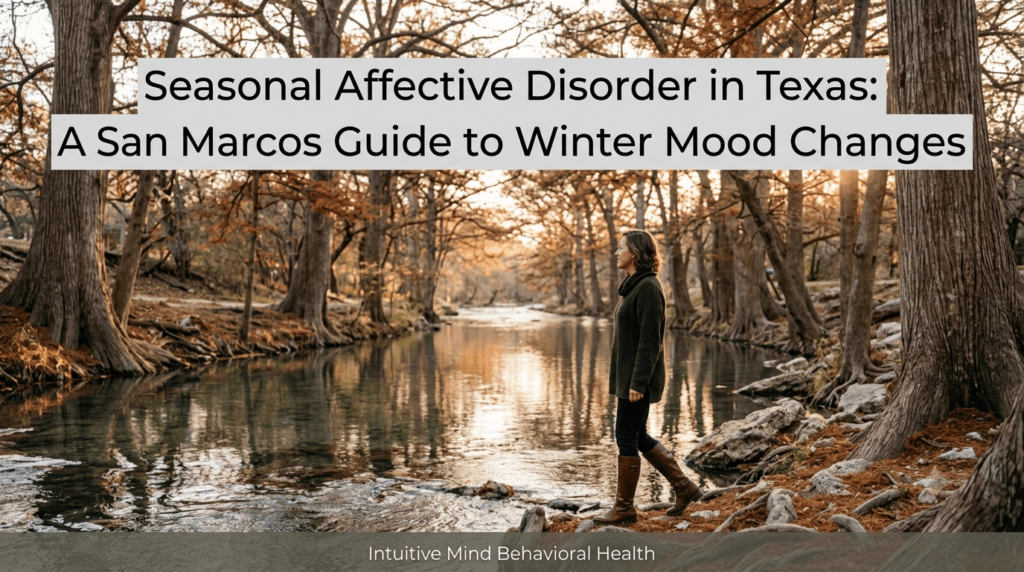
A photorealistic late afternoon scene along the calm, reflective San Marcos River lined with large, bare cypress trees and autumnal foliage. A woman wearing a green sweater and brown boots walks along the rocky riverbank under soft winter sunlight. A semi-transparent overlay at the top displays the title 'Seasonal Affective Disorder in Texas: A San Marcos Guide to Winter Mood Changes', with a subtle gray banner at the bottom reading 'Intuitive Mind Behavioral Health'.

Seasonal Affective Disorder in Texas: A San Marcos Guide to Winter Mood Changes

Understanding Winter Depression in Central Texas When people think of Seasonal Affective Disorder (SAD), they often picture freezing, snow-bound northern cities. However, residents in San Marcos, Texas—along with surrounding Hays and Guadalupe Counties—frequently experience significant seasonal mood shifts as autumn turns to winter. Even in Central Texas, shortened daylight hours between November and March alter our internal biological clocks. The shift in light exposure directly impacts brain neurochemistry, causing many high-functioning adults, university students, and busy professionals to experience unexplained fatigue, brain fog, and persistent low mood. Recognizing that winter mood changes stem from biological circadian shifts—rather than personal laziness—is the first step toward restoring your vitality year-round. 5 Signs You May Be Experiencing Seasonal Affective Disorder While occasional low-energy days are normal, SAD is characterized by a predictable pattern of depressive symptoms that emerge during specific months and resolve as spring returns: 1. Chronic Fatigue & Oversleeping (Hypersomnia) You may find it extraordinarily difficult to wake up in the morning despite sleeping 8 to 10 hours. A heavy, sluggish feeling in your body (leaden paralysis) often persists throughout the day. 2. Intense Carbohydrate Cravings & Weight Changes SAD alters appetite regulators, driving strong cravings for comforting, carbohydrate-rich foods like bread, pasta, and sweets, often leading to unexpected winter weight gain. 3. Persistent Low Mood & Anhedonia A noticeable loss of interest in activities you usually enjoy—such as spending time on the San Marcos River, hiking local trails, or socializing with friends—accompanied by lingering sadness or emptiness. 4. Difficulty Concentrating & Executive Brain Fog Struggling to complete routine work tasks, feeling mentally slow, or finding it challenging to focus during lectures or business meetings during the late fall and winter months. 5. Increased Social Withdrawal Feeling an overwhelming urge to “hibernate,” pulling away from social invitations, and isolating yourself at home until the days lengthen again. Seasonal Affective Disorder vs. Major Depressive Disorder Diagnostic Feature Seasonal Affective Disorder (SAD) Non-Seasonal Major Depression Timing & Pattern Begins in fall/winter; resolves in spring Can occur at any time of year without seasonal pattern Sleep Changes Typically excessive sleep (Hypersomnia) Frequently insomnia or fragmented sleep Appetite & Weight Increased appetite & carbohydrate cravings Variable; often loss of appetite & weight loss Energy Pattern Severe seasonal lethargy and heaviness Chronic low energy independent of daylight hours Practical Action Steps to Combat Winter SAD Living in San Marcos offers several advantages for managing winter mood shifts when paired with deliberate strategies: Integrative Psychiatric Care at Intuitive Mind At Intuitive Mind Behavioral Health, located just down I-35 from San Marcos in New Braunfels, we provide comprehensive, root-cause psychiatric evaluations for adults struggling with seasonal and major mood disorders. Led by Lydia Kimeli-Pope, MSN, PMHNP-BC, our clinical model looks beyond brief symptom checklists to address biological, environmental, and emotional root causes. Our 90-minute intake appointments give us ample time to evaluate your seasonal patterns, order targeted lab panels, and—when medication is appropriate—utilize GeneSight® pharmacogenomic testing to identify how your body metabolizes psychiatric medications. Explore our dedicated clinical service pages to learn more about anxiety care services, depression care, mood disorder treatment, and bipolar disorder care. “Seasonal depression isn’t something you just have to endure until spring. By balancing circadian chemistry and supporting the body’s natural rhythms, you can reclaim your energy year-round.” — Lydia Kimeli-Pope, MSN, PMHNP-BC Learn more about our practice values and clinical leadership on our about page. If you or a loved one is experiencing severe emotional distress, overwhelming hopelessness, or thoughts of self-harm, immediate help is available. Contact the 988 Suicide & Crisis Lifeline by calling or texting 988 for free, 24/7 confidential support. For additional clinical guidance on Seasonal Affective Disorder and depression, visit the National Institute of Mental Health (NIMH) or the Substance Abuse and Mental Health Services Administration (SAMHSA). Why San Marcos & Hays County Residents Choose Us Adults across San Marcos, Martindale, Kyle, Wimberley, and New Braunfels trust Intuitive Mind Behavioral Health for modern, patient-centered care. Reach out through our contact page to schedule a consultation. Step-by-Step Pathway to Care Starting your journey toward balanced seasonal wellness is simple and supportive. Reclaim Your Vitality This Winter You do not have to struggle through winter lethargy and low mood every year. Comprehensive, integrative psychiatric care is available close to home. We proudly serve individuals and families in San Marcos, New Braunfels, Kyle, Seguin, and across Texas via telehealth. This content is educational and does not substitute for formal clinical evaluation or medical advice. Always consult a licensed healthcare provider regarding your physical or mental health needs. About the Author Intuitive Mind Behavioral Health — Lydia Kimeli-Pope, MSN, PMHNP-BC Board-Certified Psychiatric Mental Health Nurse Practitioner Intuitive Mind Behavioral Health provides integrative psychiatric care for adults, teens, and families across San Marcos, Hays County, Comal County, and statewide via Texas telehealth. We combine evidence-based psychiatric medicine with functional lab testing, lifestyle wellness, and pharmacogenomic precision care. 📞 (830) 302-4097 🌐 intuitive-mind.com 📍 387 W. Mill St. Suite 106, New Braunfels, TX 78130 Accepting new patients. Free 15-minute consultations available.

Seasonal Affective Disorder in Texas: A San Marcos Guide to Winter Mood Changes Read More »

A mother in a cream-colored sweater kneels by her young son, who is sitting on the edge of a bed, holding his hands and comforting him. The room is a sunlit bedroom with wooden furniture and neutral-colored bedding, and a large window looks out onto trees and a house. In the upper-left, white and yellow text reads "School Refusal and Anxiety: What San Antonio Parents Can Do". A black banner at the bottom displays "Intuitive Mind Behavioral Health".

School Refusal and Anxiety: What San Antonio Parents Can Do

Understanding School Refusal in San Antonio Families As a parent in San Antonio or the surrounding Texas Hill Country, weekday mornings can rapidly escalate into distressing battles. If your child regularly cries, complains of severe stomach pain, throws intense tantrums, or flatly refuses to get into the car for school, you are not alone—and your child is not simply being “difficult.” School refusal (often called school avoidance) affects up to 5% of school-aged children. Unlike truancy, where students skip school without parental knowledge, school refusal happens with the parents’ full awareness—and usually causes immense stress for the entire family. Recognizing school avoidance as a symptom of clinical anxiety is the first critical step toward restoring calm to your mornings and confidence to your child. Common Root Causes of School Refusal School avoidance rarely stems from a single event. It is usually triggered by an interaction between underlying emotional vulnerabilities and environmental stressors: 1. Separation Anxiety Common in younger children, the fear of being away from parents or caregivers can cause panic about something bad happening to their family while they are at school. 2. Social Anxiety & Fear of Judgment Older children and teens often experience intense fear of being judged, teased, embarrassed during public speaking, or excluded by peers at school. 3. Academic Stress & Performance Panic Unaddressed learning differences, ADHD, or extreme perfectionism can turn the classroom environment into a source of constant feeling overwhelmed. 4. Somatic Stress Response Anxiety releases stress hormones like cortisol and adrenaline, causing real physical suffering—including morning vomiting, dizziness, muscle tension, and chronic headaches. School Refusal vs. Truancy: Key Differences Trait / Behavior School Refusal (Anxiety-Driven) Truancy (Behavioral) Parental Awareness Parents are fully aware; child is at home Child skips school without parents knowing Emotional State Marked by fear, panic, somatic pain, distress Marked by lack of interest, rule-breaking Academic Concern Child usually cares about grades/homework Student often lacks academic engagement Location During Hours Stays home where they feel safe Out in the community with peers Practical Action Steps for San Antonio Parents When confronting school refusal, parents can implement structured strategies while seeking professional evaluation: Integrative Pediatric Psychiatric Care at Intuitive Mind At Intuitive Mind Behavioral Health, located convenient to North San Antonio and Stone Oak in New Braunfels, we offer compassionate, root-cause psychiatric evaluations for children, teens, and young adults. Led by Lydia Kimeli-Pope, MSN, PMHNP-BC, our practice bridges the gap between biological health, emotional wellness, and academic success. We utilize 90-minute intake evaluations to give families time to share their full story. When appropriate, we order comprehensive blood work (checking thyroid function, vitamin status, and metabolic markers) and utilize GeneSight® pharmacogenomic testing to guide precise medication choices without unnecessary trial-and-error. Explore our specialized clinical services by visiting our dedicated pages for anxiety care services, depression care, mood disorder treatment, and bipolar disorder care. “Children don’t refuse school to be difficult—they do it because their nervous system feels unsafe. When we treat the underlying anxiety, school becomes manageable again.” — Lydia Kimeli-Pope, MSN, PMHNP-BC Learn more about our practice values and clinical leadership on our about page. If your child or family is facing a severe mental health crisis, immediate assistance is available. Contact the 988 Suicide & Crisis Lifeline by calling or texting 988 for free, 24/7 support. For additional clinical guidance on childhood anxiety and school refusal, visit the National Institute of Mental Health (NIMH) or the Substance Abuse and Mental Health Services Administration (SAMHSA). Why San Antonio & Hill Country Families Trust Us Families across San Antonio, Stone Oak, Garden Ridge, Schertz, and New Braunfels choose Intuitive Mind Behavioral Health for our clinical expertise and family-centered care. Connect with our clinical team today through our contact page to schedule an evaluation. Step-by-Step Pathway to Care Getting help for your child’s school anxiety is structured, supportive, and clear. Support Your Child’s Journey Back to the Classroom You do not have to struggle through difficult mornings alone. Expert, compassionate pediatric psychiatric care is available close to home. We proudly support children, teens, and families in San Antonio, New Braunfels, Stone Oak, Schertz, and across Texas via telehealth. This content is educational and does not substitute for formal clinical evaluation or medical advice. Always consult a licensed healthcare provider regarding your physical or mental health needs. About the Author Intuitive Mind Behavioral Health — Lydia Kimeli-Pope, MSN, PMHNP-BC Board-Certified Psychiatric Mental Health Nurse Practitioner Intuitive Mind Behavioral Health provides integrative psychiatric care for children, teens, young adults, and families across San Antonio, Bexar County, Comal County, and statewide via Texas telehealth. We combine evidence-based psychiatric medicine with functional lab testing, lifestyle wellness, and family-centered support. 📞 (830) 302-4097 🌐 intuitive-mind.com 📍 387 W. Mill St. Suite 106, New Braunfels, TX 78130 Accepting new patients. Free 15-minute consultations available.

School Refusal and Anxiety: What San Antonio Parents Can Do Read More »

A compassionate photo of a mother with brown hair talking to her teenage son on a couch in a living room. Text at the top reads 'Signs of Schizophrenia in Young Adults: A Seguin Parent’s Guide'. Text in a small white banner below the image reads 'Intuitive Mind Behavioral Health'.

Signs of Schizophrenia in Young Adults: A Seguin Parent’s Guide

Recognizing Early Changes in Seguin Families Raising teenagers and young adults in a historic, close-knit community like Seguin, Texas, offers wonderful community bonds. However, watching your child transition into independence can also bring hidden worries. When a young adult suddenly changes behavior, pulls away from family traditions, or seems entirely detached from reality, parents often feel a frightening sense of helplessness. Schizophrenia is a complex brain-based condition, but contrary to common media portrayals, it rarely appears overnight. It typically develops gradually through a “prodromal” phase—a subtle shifting period where behavioral and cognitive changes take root long before a formal crisis occurs. Recognizing these early signs can help parents secure timely, compassionate intervention that dramatically improves long-term outcomes. Early Warning Signs Parents Should Look For During the late teens and early twenties, brain maturation undergoes massive shifts. Distinguishing between normal adolescent moodiness and emerging psychiatric illness can be difficult. However, certain persistent patterns warrant professional attention: 1. Severe Social Withdrawal and Isolation A young adult who was previously engaged with friends, sports, or family suddenly stops communicating, locks themselves in their bedroom for days, and abandons all social connections. 2. Noticeable Drop in Academic or Occupational Functioning A bright high school or college student in Seguin suddenly experiences a sharp decline in grades, struggles to complete basic tasks, or quits a stable job without a rational explanation. 3. Suspiciousness or Paranoid Beliefs Expressing unusual, unshakeable convictions—such as believing peers, teachers, or strangers are plotting against them, watching them through devices, or talking about them behind their backs. 4. Unusual Perceptual Experiences (Hallucinations) Hearing whispers, mumbling, or distinct voices when no one is present, or seeing things that others cannot perceive. Young adults often hide these experiences out of fear until symptoms intensify. 5. Disorganized Speech and Thinking Jumping rapidly from one unrelated topic to another, creating nonsensical words, or stopping mid-sentence because their train of thought has abruptly vanished (thought blocking). Symptom Categories: Positive vs. Negative Signs Symptom Category Clinical Definition Common Behavioral Examples Positive Symptoms (Additions to normal function) Behaviors or thoughts added to a person’s experience Auditory hallucinations, visual misperceptions, paranoid delusions, bizarre ideas Negative Symptoms (Absences from normal function) Capabilities or emotions that become muted or missing Emotional flatness, lack of facial expression, severe apathy, loss of speech fluency Cognitive Symptoms Disruptions in working memory and executive processing Inability to concentrate, poor decision-making, trouble following a conversation The Integrative Approach to Youth Psychiatric Care Navigating suspected psychosis requires an unhurried, highly specialized medical evaluation. At Intuitive Mind Behavioral Health, located just a short drive from Seguin in New Braunfels, we provide sensitive, comprehensive psychiatric care for young adults and their families. Led by Lydia Kimeli-Pope, MSN, PMHNP-BC, our practice understands how frightening this journey can be for parents. Our 90-minute initial intake provides a safe, non-judgmental space to review symptoms, medical history, and developmental changes. We utilize thorough physical and laboratory screenings to rule out underlying medical or metabolic triggers, ensuring accurate diagnosis and targeted, evidence-based care. Explore our specialized clinical pathways by visiting our dedicated pages for anxiety care services, depression care, mood disorder treatment, and bipolar disorder care. “When a young adult begins showing signs of psychosis, parents need clear answers and steady guidance, not rushed appointments. We walk beside your family every step of the way.” — Lydia Kimeli-Pope, MSN, PMHNP-BC Learn more about our practice philosophy and background on our about page. If your child or loved one is experiencing an immediate psychiatric crisis or expressing thoughts of self-harm, urgent help is available. Contact the 988 Suicide & Crisis Lifeline by calling or texting 988 for free, 24/7 confidential support. For comprehensive educational materials and clinical research on early psychosis and schizophrenia, visit the National Institute of Mental Health (NIMH) or the Substance Abuse and Mental Health Services Administration (SAMHSA). Why Seguin & Guadalupe County Families Trust Us Families across Seguin, Marion, McQueeney, and Guadalupe County choose Intuitive Mind Behavioral Health for our clinical expertise and compassionate, family-centered approach. Connect with our practice today through our contact page to discuss your concerns or reserve an appointment. Step-by-Step Pathway to Care Taking the first step toward specialized care for your young adult is structured and reassuring. Get Support for Your Family Today You do not have to navigate the uncertainties of early psychosis alone. Compassionate, expert psychiatric care is available just minutes from Seguin. We proudly support families in Seguin, New Braunfels, Marion, San Marcos, and across Texas via telehealth. This content is educational and does not substitute for formal clinical evaluation or medical advice. Always consult a licensed healthcare provider regarding your physical or mental health needs. About the Author Intuitive Mind Behavioral Health — Lydia Kimeli-Pope, MSN, PMHNP-BC Board-Certified Psychiatric Mental Health Nurse Practitioner Intuitive Mind Behavioral Health provides integrative psychiatric care for children, teens, young adults, and families across Seguin, Guadalupe County, and statewide via Texas telehealth. We combine evidence-based psychiatric medicine with functional lab testing, pharmacogenomic precision care, and family-centered support. 📞 (830) 302-4097 🌐 intuitive-mind.com 📍 387 W. Mill St. Suite 106, New Braunfels, TX 78130 Accepting new patients. Free 15-minute consultations available.

Signs of Schizophrenia in Young Adults: A Seguin Parent’s Guide Read More »

Featured image titled "Signs of Schizophrenia in Young Adults: A Seguin Parent's Guide" featuring a photorealistic image of a concerned mother sitting beside her young adult son on a couch in a sunlit living room with exposed stone walls. She offers gentle emotional support by placing a hand on his shoulder. A subtle footer at the bottom reads "Intuitive Mind Behavioral Health".

Signs of Schizophrenia in Young Adults: A Seguin Parent’s Guide

Recognizing Early Changes in Seguin Families Raising teenagers and young adults in a historic, close-knit community like Seguin, Texas, offers wonderful community bonds. However, watching your child transition into independence can also bring hidden worries. When a young adult suddenly changes behavior, pulls away from family traditions, or seems entirely detached from reality, parents often feel a frightening sense of helplessness. Schizophrenia is a complex brain-based condition, but contrary to common media portrayals, it rarely appears overnight. It typically develops gradually through a “prodromal” phase—a subtle shifting period where behavioral and cognitive changes take root long before a formal crisis occurs. Recognizing these early signs can help parents secure timely, compassionate intervention that dramatically improves long-term outcomes. Early Warning Signs Parents Should Look For During the late teens and early twenties, brain maturation undergoes massive shifts. Distinguishing between normal adolescent moodiness and emerging psychiatric illness can be difficult. However, certain persistent patterns warrant professional attention: 1. Severe Social Withdrawal and Isolation A young adult who was previously engaged with friends, sports, or family suddenly stops communicating, locks themselves in their bedroom for days, and abandons all social connections. 2. Noticeable Drop in Academic or Occupational Functioning A bright high school or college student in Seguin suddenly experiences a sharp decline in grades, struggles to complete basic tasks, or quits a stable job without a rational explanation. 3. Suspiciousness or Paranoid Beliefs Expressing unusual, unshakeable convictions—such as believing peers, teachers, or strangers are plotting against them, watching them through devices, or talking about them behind their backs. 4. Unusual Perceptual Experiences (Hallucinations) Hearing whispers, mumbling, or distinct voices when no one is present, or seeing things that others cannot perceive. Young adults often hide these experiences out of fear until symptoms intensify. 5. Disorganized Speech and Thinking Jumping rapidly from one unrelated topic to another, creating nonsensical words, or stopping mid-sentence because their train of thought has abruptly vanished (thought blocking). Symptom Categories: Positive vs. Negative Signs Symptom Category Clinical Definition Common Behavioral Examples Positive Symptoms (Additions to normal function) Behaviors or thoughts added to a person’s experience Auditory hallucinations, visual misperceptions, paranoid delusions, bizarre ideas Negative Symptoms (Absences from normal function) Capabilities or emotions that become muted or missing Emotional flatness, lack of facial expression, severe apathy, loss of speech fluency Cognitive Symptoms Disruptions in working memory and executive processing Inability to concentrate, poor decision-making, trouble following a conversation The Integrative Approach to Youth Psychiatric Care Navigating suspected psychosis requires an unhurried, highly specialized medical evaluation. At Intuitive Mind Behavioral Health, located just a short drive from Seguin in New Braunfels, we provide sensitive, comprehensive psychiatric care for young adults and their families. Led by Lydia Kimeli-Pope, MSN, PMHNP-BC, our practice understands how frightening this journey can be for parents. Our 90-minute initial intake provides a safe, non-judgmental space to review symptoms, medical history, and developmental changes. We utilize thorough physical and laboratory screenings to rule out underlying medical or metabolic triggers, ensuring accurate diagnosis and targeted, evidence-based care. Explore our specialized clinical pathways by visiting our dedicated pages for anxiety care services, depression care, mood disorder treatment, and bipolar disorder care. “When a young adult begins showing signs of psychosis, parents need clear answers and steady guidance, not rushed appointments. We walk beside your family every step of the way.” — Lydia Kimeli-Pope, MSN, PMHNP-BC Learn more about our practice philosophy and background on our about page. If your child or loved one is experiencing an immediate psychiatric crisis or expressing thoughts of self-harm, urgent help is available. Contact the 988 Suicide & Crisis Lifeline by calling or texting 988 for free, 24/7 confidential support. For comprehensive educational materials and clinical research on early psychosis and schizophrenia, visit the National Institute of Mental Health (NIMH) or the Substance Abuse and Mental Health Services Administration (SAMHSA). Why Seguin & Guadalupe County Families Trust Us Families across Seguin, Marion, McQueeney, and Guadalupe County choose Intuitive Mind Behavioral Health for our clinical expertise and compassionate, family-centered approach. Connect with our practice today through our contact page to discuss your concerns or reserve an appointment. Step-by-Step Pathway to Care Taking the first step toward specialized care for your young adult is structured and reassuring. Get Support for Your Family Today You do not have to navigate the uncertainties of early psychosis alone. Compassionate, expert psychiatric care is available just minutes from Seguin. We proudly support families in Seguin, New Braunfels, Marion, San Marcos, and across Texas via telehealth. This content is educational and does not substitute for formal clinical evaluation or medical advice. Always consult a licensed healthcare provider regarding your physical or mental health needs. About the Author Intuitive Mind Behavioral Health — Lydia Kimeli-Pope, MSN, PMHNP-BC Board-Certified Psychiatric Mental Health Nurse Practitioner Intuitive Mind Behavioral Health provides integrative psychiatric care for children, teens, young adults, and families across Seguin, Guadalupe County, and statewide via Texas telehealth. We combine evidence-based psychiatric medicine with functional lab testing, pharmacogenomic precision care, and family-centered support. 📞 (830) 302-4097 🌐 intuitive-mind.com 📍 387 W. Mill St. Suite 106, New Braunfels, TX 78130 Accepting new patients. Free 15-minute consultations available.

Signs of Schizophrenia in Young Adults: A Seguin Parent’s Guide Read More »

A photorealistic photograph capturing a quiet, intimate moment of mutual support in a sunlit, comfortable living room of a historic Central Texas home near Seguin. An older woman, a concerned parent, sits beside a young adult child on a plush leather sofa. The parent has a gentle, worried expression and is holding the child's arm; the child is looking down with a pensive, averted gaze, conveying a shared emotional burden. A large window on the left lets in warm, golden afternoon light, illuminating antique wooden furniture and framed family photos on a limestone mantelpiece. In the upper third of the image, a modern, clean, semi-transparent text overlay reads: "Signs of Schizophrenia in Young Adults: A Seguin Parent's Guide". At the bottom of the image, a subtle footer displays the text: "Intuitive Mind Behavioral Health".

Signs of Schizophrenia in Young Adults: A Seguin Parent’s Guide

Recognizing Early Changes in Seguin Families Raising teenagers and young adults in a historic, close-knit community like Seguin, Texas, offers wonderful community bonds. However, watching your child transition into independence can also bring hidden worries. When a young adult suddenly changes behavior, pulls away from family traditions, or seems entirely detached from reality, parents often feel a frightening sense of helplessness. Schizophrenia is a complex brain-based condition, but contrary to common media portrayals, it rarely appears overnight. It typically develops gradually through a “prodromal” phase—a subtle shifting period where subtle behavioral and cognitive changes take root long before a formal crisis occurs. Recognizing these early signs can help parents secure timely, compassionate intervention that dramatically improves long-term outcomes. Early Warning Signs Parents Should Look For During the late teens and early twenties, brain maturation undergoes massive shifts. Distinguishing between normal adolescent moodiness and emerging psychiatric illness can be difficult. However, certain persistent patterns warrant professional attention: 1. Severe Social Withdrawal and Isolation A young adult who was previously engaged with friends, sports, or family suddenly stops communicating, locks themselves in their bedroom for days, and abandons all social connections. 2. Noticeable Drop in Academic or Occupational Functioning A bright high school or college student in Seguin suddenly experiences a sharp decline in grades, struggles to complete basic tasks, or quits a stable job without a rational explanation. 3. Suspiciousness or Paranoid Beliefs Expressing unusual, unshakeable convictions—such as believing peers, teachers, or strangers are plotting against them, watching them through devices, or talking about them behind their backs. 4. Unusual Perceptual Experiences (Hallucinations) Hearing whispers, mumbling, or distinct voices when no one is present, or seeing things that others cannot perceive. Young adults often hide these experiences out of fear until symptoms intensify. 5. Disorganized Speech and Thinking Jumping rapidly from one unrelated topic to another, creating nonsensical words, or stopping mid-sentence because their train of thought has abruptly vanished (thought blocking). Symptom Categories: Positive vs. Negative Signs Symptom Category Clinical Definition Common Behavioral Examples Positive Symptoms (Additions to normal function) Behaviors or thoughts added to a person’s experience Auditory hallucinations, visual misperceptions, paranoid delusions, bizarre ideas Negative Symptoms (Absences from normal function) Capabilities or emotions that become muted or missing Emotional flatness, lack of facial expression, severe apathy, loss of speech fluency Cognitive Symptoms Disruptions in working memory and executive processing Inability to concentrate, poor decision-making, trouble following a conversation The Integrative Approach to Youth Psychiatric Care Navigating suspected psychosis requires an unhurried, highly specialized medical evaluation. At Intuitive Mind Behavioral Health, located just a short drive from Seguin in New Braunfels, we provide sensitive, comprehensive psychiatric care for young adults and their families. Led by Lydia Kimeli-Pope, MSN, PMHNP-BC, our practice understands how frightening this journey can be for parents. Our 90-minute initial intake provides a safe, non-judgmental space to review symptoms, medical history, and developmental changes. We utilize thorough physical and laboratory screenings to rule out underlying medical or metabolic triggers, ensuring accurate diagnosis and targeted, evidence-based care. Explore our specialized clinical pathways by visiting our dedicated pages for anxiety care services, depression care, mood disorder treatment, and bipolar disorder care. “When a young adult begins showing signs of psychosis, parents need clear answers and steady guidance, not rushed appointments. We walk beside your family every step of the way.” — Lydia Kimeli-Pope, MSN, PMHNP-BC Learn more about our practice philosophy and background on our about page. If your child or loved one is experiencing an immediate psychiatric crisis or expressing thoughts of self-harm, urgent help is available. Contact the 988 Suicide & Crisis Lifeline by calling or texting 988 for free, 24/7 confidential support. For comprehensive educational materials and clinical research on early psychosis and schizophrenia, visit the National Institute of Mental Health (NIMH) or the Substance Abuse and Mental Health Services Administration (SAMHSA). Why Seguin & Guadalupe County Families Trust Us Families across Seguin, Marion, McQueeney, and Guadalupe County choose Intuitive Mind Behavioral Health for our clinical expertise and compassionate, family-centered approach. Connect with our practice today through our contact page to discuss your concerns or reserve an appointment. Step-by-Step Pathway to Care Taking the first step toward specialized care for your young adult is structured and reassuring. Get Support for Your Family Today You do not have to navigate the uncertainties of early psychosis alone. Compassionate, expert psychiatric care is available just minutes from Seguin. We proudly support families in Seguin, New Braunfels, Marion, San Marcos, and across Texas via telehealth. This content is educational and does not substitute for formal clinical evaluation or medical advice. Always consult a licensed healthcare provider regarding your physical or mental health needs. About the Author Intuitive Mind Behavioral Health — Lydia Kimeli-Pope, MSN, PMHNP-BC Board-Certified Psychiatric Mental Health Nurse Practitioner Intuitive Mind Behavioral Health provides integrative psychiatric care for children, teens, young adults, and families across Seguin, Guadalupe County, and statewide via Texas telehealth. We combine evidence-based psychiatric medicine with functional lab testing, pharmacogenomic precision care, and family-centered support. 📞 (830) 302-4097 🌐 intuitive-mind.com 📍 387 W. Mill St. Suite 106, New Braunfels, TX 78130 Accepting new patients. Free 15-minute consultations available.

Signs of Schizophrenia in Young Adults: A Seguin Parent’s Guide Read More »

A photorealistic photograph capturing an adult woman in a quiet, thoughtful moment. She is sitting by a large, rustic wooden window, looking out at a sweeping view of the rolling Texas Hill Country during a warm, golden sunrise. The atmosphere conveys a sense of deep relief and renewal. A semi-transparent overlay in the upper third contains the modern text: "Medication Management Myths Hunter Patients Should Stop Believing". A subtle footer at the bottom of the image displays the text: "Intuitive Mind Behavioral Health".

Medication Management Myths Hunter Patients Should Stop Believing

Clearing Up Psychiatric Medication Confusion in Hunter, Texas Located along the historic corridor between San Marcos and New Braunfels, the quiet community of Hunter, Texas, offers a peaceful rural pace. However, when mental health struggles like severe anxiety, depression, or emotional burnout arise, navigating psychiatric treatment can feel overwhelming. For many adults in Hunter and surrounding Comal County, misconceptions about psychiatric medications create unnecessary hesitation. Fear of changing your personality, becoming dependent on pills, or enduring endless trial-and-error often prevents people from seeking life-changing medical support. Understanding what psychiatric medication management actually involves is the first step toward reclaiming your health. 5 Medication Management Myths Hunter Residents Need to Stop Believing Let’s dismantle five of the most pervasive myths surrounding outpatient psychiatric medication management: Myth 1: “Psychiatric Medication Will Change My Personality” The Reality: The goal of evidence-based medication is to reduce debilitating symptoms—such as intrusive worry, profound low mood, or severe mood swings—so your authentic personality can shine through. Proper dosing restores neurochemical balance; it does not turn you into a “zombie” or alter your core self. Myth 2: “If I Start Medication, I’ll Be on It for the Rest of My Life” The Reality: Psychiatric prescriptions are tools, not life sentences. Depending on your diagnosis and history, medication may be used short-term to stabilize an acute crisis or calm an overactive nervous system while you establish holistic coping strategies and lifestyle habits. Myth 3: “Finding the Right Med Means Months of Horrible Trial and Error” The Reality: While every brain is unique, modern technology has greatly reduced the guessing game. Through GeneSight® pharmacogenomic testing, a simple cheek swab analyzes how your genes break down specific psychiatric medications, guiding your provider toward choices with the highest likelihood of success and lowest risk of side effects. Myth 4: “Medication Management Is Just a 5-Minute Script Refill” The Reality: High-quality psychiatric care looks at the whole person. Comprehensive medication management involves tracking physical labs (thyroid, vitamin D, inflammatory markers), reviewing sleep quality, assessing stress levels, and evaluating how your treatment interacts with your daily routine. Myth 5: “Taking Medication Means I Failed at Managing Stress on My Own” The Reality: Mental health conditions involve measurable physiological, hormonal, and neurochemical shifts. Seeking medical support for clinical anxiety or depression is no different than using insulin for diabetes or taking medication for high blood pressure—it is a proactive health choice. Traditional Psychiatry vs. Integrative Medication Management Feature / Standard Traditional Med Checks Integrative Medication Management Initial Intake Time 15 to 30 minutes 90 minutes (Unhurried deep-dive) Lab Work Scope Basic or none Comprehensive blood, hormonal & metabolic panels Genomic Precision Rare (Trial & error approach) GeneSight® DNA testing integration Care Focus Symptom suppression Root-cause identification & whole-person wellness Follow-Up Style Brief script updates Ongoing collaborative progress monitoring The Integrative Psychiatry Approach at Intuitive Mind At Intuitive Mind Behavioral Health, located just minutes down the road from Hunter in New Braunfels, we provide psychiatric medication management rooted in empathy, science, and individualized care. Led by Lydia Kimeli-Pope, MSN, PMHNP-BC, our clinical approach combines pharmaceutical precision with functional lab evaluation, lifestyle modifications, and open communication. Discover our specialized care options by visiting our practice pages for anxiety care services, depression care, mood disorder treatment, and bipolar disorder care. “Medication should open the door to healing, not be a substitute for understanding your story. We prescribe with precision and partner with you every step of the way.” — Lydia Kimeli-Pope, MSN, PMHNP-BC Learn more about our practice values and clinical leadership on our about page. If you or someone you know is in severe emotional distress or facing a psychiatric crisis, immediate help is available. Contact the 988 Suicide & Crisis Lifeline by calling or texting 988 for free, 24/7 confidential support. For comprehensive mental health guidelines and evidence-based research, visit the National Institute of Mental Health (NIMH) or the Substance Abuse and Mental Health Services Administration (SAMHSA). Why Hunter & Comal County Residents Partner with Us Residents across Hunter, York Creek, San Marcos, and New Braunfels rely on Intuitive Mind Behavioral Health for modern, patient-first care. Ready to explore your options? Visit our contact page to ask questions or schedule an evaluation. Step-by-Step Pathway to Care Starting your medication management journey is simple and structured. Take Control of Your Health Today Don’t let outdated myths hold you back from feeling like yourself again. Precise, thoughtful psychiatric medication management is available close to home. We proudly support patients in Hunter, New Braunfels, San Marcos, Seguin, and across Texas via telehealth. This content is educational and does not substitute for formal clinical evaluation or medical advice. Always consult a licensed healthcare provider regarding your physical or mental health needs. About the Author Intuitive Mind Behavioral Health — Lydia Kimeli-Pope, MSN, PMHNP-BC Board-Certified Psychiatric Mental Health Nurse Practitioner Intuitive Mind Behavioral Health provides integrative psychiatric evaluations and medication management for adults, teens, and families across Hunter, Comal County, and statewide via Texas telehealth. We combine evidence-based psychiatric care with functional blood panels, GeneSight® testing, and lifestyle wellness. 📞 (830) 302-4097 🌐 intuitive-mind.com 📍 387 W. Mill St. Suite 106, New Braunfels, TX 78130 Accepting new patients. Free 15-minute consultations available.

Medication Management Myths Hunter Patients Should Stop Believing Read More »

A serene, photorealistic landscape photograph capturing a panoramic view over Canyon Lake, Texas, during a warm, golden-hour sunrise. The tranquil water reflects the soft orange and pink light of the sky, with rolling hills and juniper trees in the distance. A small, rustic fishing dock and a single rowboat are moored in a quiet cove on the right. A large, semi-transparent overlay banner in the upper third contains the elegant, serif text: "Choosing the Right Psychiatric Provider in Canyon Lake". A subtle, understated footer bar at the bottom displays the text: "Intuitive Mind Behavioral Health". The overall mood is peaceful, reflective, and hopeful.

Choosing the Right Psychiatric Provider in Canyon Lake

Navigating Mental Healthcare in Canyon Lake, Texas Living near Canyon Lake offers unmatched natural beauty, quiet communities like Sattler and Startzville, and a relaxing Texas Hill Country lifestyle. However, finding specialized medical healthcare—especially mental health services—can feel overwhelming when navigating regional options across Comal County. Whether you are coping with persistent anxiety, long-term low mood, dynamic emotional shifts, or life transitions, finding the right psychiatric provider in Canyon Lake is the single most important step toward regaining clarity and balance. 5 Essential Criteria for Choosing a Psychiatric Provider When searching for psychiatric care tailored to your life, consider these core standards: 1. Provider Credentials & Scope of Practice Psychiatric Mental Health Nurse Practitioners (PMHNP-BC) and Psychiatrists (MD/DO) are advanced practice clinical specialists qualified to diagnose complex psychiatric conditions, order lab work, and prescribe medications. If your primary goal is medical evaluation or medication support, select a licensed psychiatric medical provider rather than a general therapist. 2. Time Spent During Evaluation Many traditional practices rely on 15-minute “medication management” slots. Healing takes time. Look for a practice offering comprehensive initial intakes (60 to 90 minutes) so your full personal, medical, and emotional history can be thoroughly understood. 3. Root-Cause & Integrative Methodology Psychiatric symptoms rarely exist in a vacuum. Nutrient deficiencies, thyroid dysregulation, sleep fragmentation, and gut health heavily influence brain function. Choose a practitioner who utilizes functional blood panels, lifestyle interventions, and precision genomic testing. 4. Patient-Centered Collaboration A great provider does not simply hand down a generic prescription. They partner with you, respecting your autonomy, values, and preferences to co-create a treatment plan you feel completely comfortable with. 5. Local Accessibility & Telehealth Convenience Select a provider who understands the geography of Comal County. Having access to an in-person clinic nearby in New Braunfels alongside flexible Texas telehealth ensures consistent care without stressful commutes. Mental Health Provider Types Compared Feature / Specialty Psychiatric Provider (PMHNP / Psychiatrist) Licensed Therapist (LPC / LCSW) Primary Care Physician (PCP) Comprehensive Psychiatric Diagnosis Yes (Specialized) Yes (Non-Medical) Broad / General Prescribes & Manages Medications Yes No Yes (Basic) Orders Functional & Blood Labs Yes No Yes Conducts In-Depth Psychotherapy Integrative / Supportive Yes (Primary Focus) Rarely Session Length 30 to 90 Minutes 45 to 60 Minutes 10 to 15 Minutes The Integrative Psychiatry Approach at Intuitive Mind At Intuitive Mind Behavioral Health, located just down the road from Canyon Lake in New Braunfels, we believe every individual deserves care that sees the whole person—not just a diagnostic code. Led by Lydia Kimeli-Pope, MSN, PMHNP-BC, our practice bridges the gap between biological medicine, emotional health, and lifestyle wellness. We specialize in comprehensive, compassionate care for children, teens, young adults, and women. Explore our tailored clinical pathways by visiting our dedicated pages for anxiety care services, depression care, mood disorder treatment, and bipolar disorder care. “I don’t hand you a treatment plan—I co-create it with you. Healing happens when you feel safe, heard, and deeply understood.” — Lydia Kimeli-Pope, MSN, PMHNP-BC Learn more about our practice philosophy and background on our about page. If you or a loved one is experiencing an urgent mental health crisis, immediate help is available. Contact the 988 Suicide & Crisis Lifeline by calling or texting 988 for free, 24/7 confidential support. For additional clinical guidelines and educational resources on mental health, visit the National Institute of Mental Health (NIMH) or the Substance Abuse and Mental Health Services Administration (SAMHSA). Why Canyon Lake & Comal County Residents Choose Us Residents across Canyon Lake, Sattler, Startzville, Spring Branch, and Bulverde choose Intuitive Mind Behavioral Health for our accessible, high-touch clinical standard. Connect with our practice today through our contact page to ask questions or reserve an appointment. Step-by-Step Pathway to Care Getting started with a trusted provider is simple, transparent, and structured. Take the Next Step Toward Quality Care Today You do not have to navigate mental health challenges alone or settle for rushed care. Connect with a trusted psychiatric provider near Canyon Lake today. We proudly support individuals and families in Canyon Lake, Spring Branch, Bulverde, New Braunfels, and across Texas via telehealth. This content is educational and does not substitute for formal clinical evaluation or medical advice. Always consult a licensed healthcare provider regarding your physical or mental health needs. About the Author Intuitive Mind Behavioral Health — Lydia Kimeli-Pope, MSN, PMHNP-BC Board-Certified Psychiatric Mental Health Nurse Practitioner Intuitive Mind Behavioral Health provides integrative psychiatric care for children, teens, young adults, and women across Canyon Lake, Comal County, and statewide via Texas telehealth. We combine evidence-based psychiatric medicine with functional lab testing, lifestyle wellness, and pharmacogenomic precision care. 📞 (830) 302-4097 🌐 intuitive-mind.com 📍 387 W. Mill St. Suite 106, New Braunfels, TX 78130 Accepting new patients. Free 15-minute consultations available.

Choosing the Right Psychiatric Provider in Canyon Lake Read More »

A photorealistic image set in a rustic Central Texas home, featuring an adult woman sitting calmly in a leather armchair next to an open window during the early morning. She is looking out at an oak tree landscape with a peaceful expression, symbolizing personal healing. A translucent overlay banner in the upper third contains the modern text: "How Childhood Trauma Shows Up in Zorn Adults." A subtle footer banner at the bottom displays the text: "Intuitive Mind Behavioral Health."

How Childhood Trauma Shows Up in Zorn Adults

Understanding Childhood Trauma in Zorn, Texas Living in the quiet, semi-rural community of Zorn in northern Guadalupe County offers space, strong local roots, and a peaceful pace of life. However, physical distance from urban centers does not protect individuals from carrying the weight of early life stress into adulthood. Childhood trauma does not only stem from overt abuse or dramatic single events. It often arises from chronic emotional neglect, unpredictable household dynamics, growing up around addiction, or long-term family instability. Many high-functioning adults in Zorn carry unhealed early trauma without realizing it, attributing their daily struggles to “stress,” “burnout,” or “just my personality.” 5 Ways Childhood Trauma Shows Up in Adulthood When early environments require constant adaptation, the nervous system builds survival habits. In adult life, these habits often show up as persistent psychological and physical symptoms: 1. Chronic Hyper-Vigilance and Anxiety Adults with unaddressed trauma often feel as though their nervous system is permanently set to “high alert.” You may constantly scan rooms for tension, over-analyze subtle tone shifts in family or coworkers, or feel an background baseline of dread. 2. People-Pleasing & Perfectionism If earning safety or attention as a child required being “the good kid” or making no mistakes, adult life often involves severe perfectionism. Setting boundaries feels terrifying, and saying “no” triggers intense guilt. 3. Emotional Numbness & Dissociation To survive overwhelming distress as a child, the mind learns to check out. In adults, this looks like feeling detached from your body, struggling to identity what you feel, or describing painful life events with complete emotional flatness. 4. Unexplained Physical & Somatic Symptoms Trauma lives in the nervous system and biological pathways. Adults frequently experience chronic migraines, persistent neck/back pain, gut dysbiosis, IBS, or autoimmune flare-ups that standard medical tests fail to fully resolve. 5. Relationship Volatility or Avoidance Early trauma impacts attachment style. You may find yourself pulling away when a partner gets too close (fear of intimacy) or holding on tightly out of fear of abandonment, creating cycles of chronic relationship distress. Symptom Comparison: Stress vs. Unresolved Trauma Life Area General Adult Stress Unresolved Childhood Trauma Nervous System Settles down after a busy week or event Remains in perpetual fight, flight, or freeze state Relational Trust Generally open; cautious when appropriate Chronic distrust, push-pull dynamics, intense fear of rejection Self-Worth Tied to temporary setbacks or achievements Deep core belief of being defective, unlovable, or unsafe Physical Health Temporary fatigue or tension headache Chronic somatic pain, sleep fragmentation, nutrient/hormonal depletion An Integrative Approach to Trauma Recovery Healing from childhood trauma requires more than a standard 15-minute medication check. Because trauma reshapes neural pathways, hormonal stress responses, and physiological health, comprehensive recovery requires a root-cause framework. At Intuitive Mind Behavioral Health, located just a short drive from Zorn in New Braunfels, we offer compassionate, trauma-informed psychiatric care designed to restore neurochemical and physical balance. Our 90-minute initial evaluation allows ample time to understand your story without rushing. We utilize targeted functional blood work to assess thyroid health, vitamin D, B-complex vitamins, and inflammatory markers—all of which are frequently impacted by long-term stress. When medication management is appropriate to calm an overactive nervous system or stabilize mood, we utilize GeneSight® pharmacogenomic testing to evaluate how your DNA processes medications, avoiding frustrating trial-and-error. Explore our comprehensive care approaches by visiting our dedicated pages for anxiety care services, depression care, mood disorder treatment, and bipolar disorder care. “Trauma isn’t just what happened to you in the past—it’s how your nervous system holds the story today. True healing restores balance to both mind and body.” — Lydia Kimeli-Pope, MSN, PMHNP-BC Learn more about our practice philosophy and background on our about page. If you or a loved one is experiencing severe emotional distress or a psychiatric crisis, immediate help is available. Contact the 988 Suicide & Crisis Lifeline by calling or texting 988 for free, 24/7 support. For additional educational resources on trauma, complex PTSD, and recovery, visit the National Institute of Mental Health (NIMH) or the Substance Abuse and Mental Health Services Administration (SAMHSA). Why Zorn & Guadalupe County Adults Choose Intuitive Mind Behavioral Health Intuitive Mind Behavioral Health is led by Lydia Kimeli-Pope, MSN, PMHNP-BC—a Board-Certified Psychiatric Mental Health Nurse Practitioner specializing in root-cause, trauma-informed care for adults and young adults. Located in nearby New Braunfels, our practice proudly serves adults throughout Zorn, York Creek, San Marcos, Seguin, and Guadalupe County. Reach out through our contact page to schedule an evaluation. Step-by-Step Pathway to Care Beginning your healing journey is structured, safe, and supportive. Reclaim Your Health and Peace of Mind Today You do not have to carry the heavy weight of childhood trauma for the rest of your life. Root-cause, trauma-informed psychiatric care is available right near Zorn. Take the first step toward lasting wellness today: We proudly support individuals in Zorn, York Creek, New Braunfels, Seguin, and across Texas via telehealth. This content is educational and does not substitute for formal clinical evaluation or medical advice. Always consult a licensed healthcare provider regarding your physical or mental health needs. About the Author Intuitive Mind Behavioral Health — Lydia Kimeli-Pope, MSN, PMHNP-BC Board-Certified Psychiatric Mental Health Nurse Practitioner Intuitive Mind Behavioral Health provides integrative psychiatric care for adults, teens, and families across Zorn, Guadalupe County, Comal County, and statewide via telehealth. We combine evidence-based psychiatric medicine with functional lab testing, nutritional wellness, and pharmacogenomic precision care. 📞 (830) 302-4097 🌐 intuitive-mind.com 📍 387 W. Mill St. Suite 106, New Braunfels, TX 78130 Accepting new patients. Free 15-minute consultations available.

How Childhood Trauma Shows Up in Zorn Adults Read More »

Skip to content