
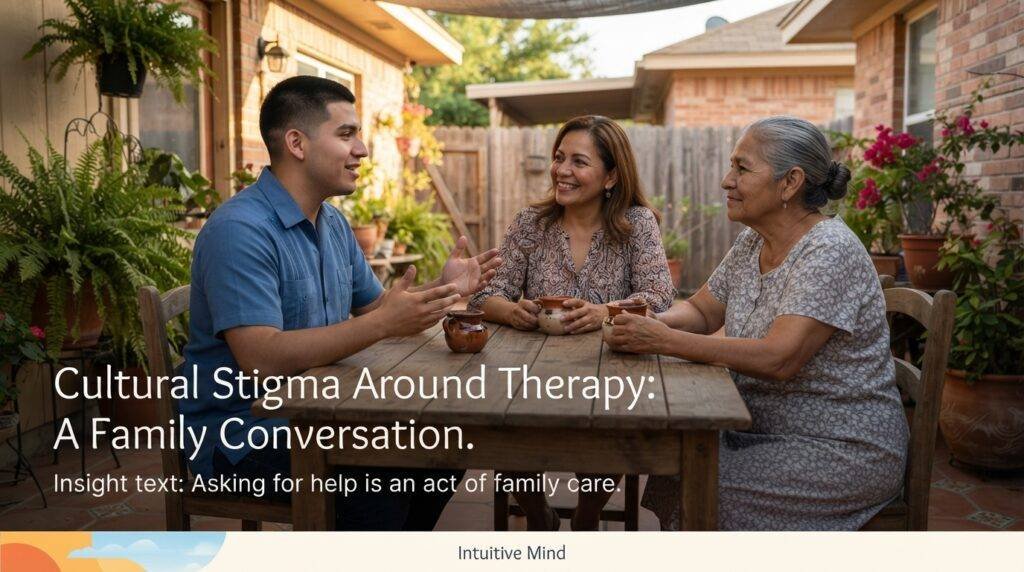
When “We Don’t Talk About That” Gets in the Way
Maybe you grew up hearing that problems at home stay at home. Maybe your mother handled everything without complaint, and your father worked through every hardship without saying a word. Maybe someone in your family has been struggling for years, but nobody calls it depression or anxiety; they just say he’s “nervous” or she’s “going through something.” If any of this sounds familiar, you’ve seen how mental health stigma can shape the way families handle pain, often out of love, pride, and a deep desire to protect one another.
In many Laredo families, strength is measured by how much you can carry. Taking care of each other, leaning on faith, and pushing through hard times are values passed down through generations. These values have helped families survive and thrive through difficult circumstances.
But sometimes those same values make it hard to say, “I’m not okay,” or “I think I need help.” People worry about what others will say, about being seen as weak, or about bringing shame to the family. So they wait, sometimes for years, until things become a crisis.
These feelings aren’t unique to any one community. Stigma around mental health exists everywhere. But it can look different from family to family, shaped by culture, faith, language, generation, and experience.
This guide is an invitation to a conversation. It explores where stigma comes from, how it affects families, how to talk about mental health at home, and how to take a first step toward care in a way that respects your values. Let’s start by understanding what stigma is.

Understanding Mental Health Stigma in Families
Mental health stigma is the set of negative beliefs, attitudes, and fears that surround mental health conditions and the people who seek help for them. It can come from the outside, through the judgment of others, or from the inside, when people turn those beliefs against themselves.
NAMI has highlighted that stigma, along with barriers like language, cost, and access to care, can keep people in many communities from getting the mental health support they need.
Common forms of stigma include:
- Public stigma: worrying that others will judge, gossip, or treat you differently
- Self-stigma: believing that needing help means you’re weak or have failed
- Family stigma: fearing that a loved one’s struggles will reflect badly on the family
- Generational beliefs: messages passed down, like “therapy is for other people” or “just pray and it will pass”
How stigma shows up in daily life. It might sound like:
- “Don’t tell anyone our business.”
- “You just need to be stronger.”
- “Your grandparents went through worse and never complained.”
- “Therapy is for people who are really sick.”
- “If you have faith, you don’t need that.”
These messages often come from love and a desire to protect. But they can leave people feeling alone with problems that are very treatable.
Values that can work with care, not against it. Many families place great importance on family closeness, respect for elders, faith, hard work, and resilience. These aren’t obstacles to mental health care. In fact, they can be powerful supports. Family can encourage treatment, faith can offer comfort and meaning, and resilience can help people stay with care when it gets hard.
How Stigma Affects Health and Families
Stigma doesn’t just make conversations awkward. It can have real consequences for individuals and families.
Delayed care. People often wait until symptoms are severe before seeking help. By then, depression, anxiety, or trauma may be harder to treat, and daily life may already be affected.
Symptoms showing up in other ways. When emotional pain can’t be talked about, it may show up as headaches, stomach problems, back pain, exhaustion, or trouble sleeping. People may visit doctors repeatedly without anyone addressing the underlying stress or depression.
Turning to other coping methods. Some people rely on alcohol, overwork, or withdrawal to manage pain they don’t feel allowed to talk about.
Children learning to stay quiet. Kids notice how adults handle emotions. When feelings are hidden, children may learn that their own worries or sadness should be kept secret too.
Strain on relationships. Unspoken struggles can lead to tension, misunderstandings, and distance between family members who love each other.
Language and access barriers. For families who prefer Spanish, finding care in their language can be another hurdle. SAMHSA recognizes language access and culturally responsive care as important parts of reducing barriers to treatment.
[CLINICIAN’S NOTE] Two patterns we see often: waiting until a crisis to seek help, and treating physical symptoms without asking about stress or mood. Many people come to care only after years of headaches, sleep problems, or stomach issues that turned out to be connected to depression or anxiety. Getting help earlier usually means a shorter, easier road. And seeking care doesn’t mean giving up your values or your faith; good care respects both.
How to Start the Conversation at Home
Talking about mental health with family can feel uncomfortable, especially if it’s never been done before. These approaches can make it easier.
Choose a calm moment. Avoid starting during an argument or a stressful event. A quiet drive, a walk, or time over coffee can feel less intense.
Speak from care, not criticism. Try “I’ve noticed you seem really tired lately, and I’m worried about you” instead of “Something’s wrong with you.”
Use words that feel comfortable. Not everyone relates to terms like “depression” or “anxiety.” It’s okay to talk about stress, nerves, sleep, worry, or feeling overwhelmed.
Connect help to family values. Seeking care can be framed as a way to be a better parent, partner, or son or daughter, and as a way to keep the family strong.
Respect faith. For many families, faith is central. Prayer and spiritual support can go hand in hand with professional care. Many people find that therapy and faith strengthen each other.
Share information gently. Explaining that depression and anxiety are health conditions, like diabetes or high blood pressure, can help reduce shame. Just as no one would tell a family member to simply be stronger about high blood sugar, emotional health deserves the same practical attention and care.
Be patient. Some family members may need time. The first conversation plants a seed, even if the answer isn’t yes right away. Returning to the topic gently over time often matters more than one perfect talk.
Lead by example. If you get help yourself and talk about it openly, you show others that it’s safe and normal.
What Care Can Look Like
For many people, the idea of therapy or psychiatric care feels intimidating. Understanding what care actually involves can ease some of that fear.
A private, respectful evaluation. A comprehensive psychiatric evaluation is a conversation about how you’re feeling, sleeping, and coping, along with your health, family, and life circumstances. You decide what to share. Care should respect your culture, faith, and family values.
Help for depression. Depression is common and treatable. It can look like sadness, but also irritability, exhaustion, loss of interest, or physical aches. Treatment may include therapy, lifestyle support, and medication when appropriate. Learn more about our approach to depression treatment.
Help for anxiety and “nervios.” Constant worry, tension, trouble sleeping, and feeling on edge are often signs of anxiety, which responds well to treatment. See how we approach anxiety and panic treatment.
Support for children and teens. Young people often feel caught between their family’s values and the pressures of school, friends, and social media. Early support can make a big difference. Our page on children’s mental health care explains how parents are involved.
Medication, when appropriate. Some people worry that medication will change who they are. Your prescriber will discuss options, benefits, and side effects, and decisions are made together. When medication is being considered, pharmacogenomic testing may provide information about how your genes could affect your response to certain medications. It doesn’t guarantee the right medication, but it can help guide choices.
Looking at the whole person. Functional and hormonal lab testing may be recommended when symptoms suggest a physical contributor, such as thyroid problems. Sleep, nutrition, physical activity, and stress all matter.
Including family on your terms. Some people prefer to start care privately and involve family later. Others feel more comfortable bringing a spouse, parent, or adult child into the conversation from the beginning. Either approach is okay. With your permission, family members can learn how to support you, what to expect from treatment, and how to recognize when you might need extra help. Care can strengthen family bonds rather than threaten them.
Starting small. The first step doesn’t have to be a big commitment. It can be a single phone call with questions, one evaluation to understand what’s going on, or a conversation with your primary care provider about how you’ve been feeling. Many people find that once they take that first small step, the next ones feel much less intimidating.
Privacy and telehealth. For families concerned about being seen at a clinic, telehealth offers private appointments from home. Your health information is protected by privacy laws, and your provider can explain how your records are handled.
Language options. If you or a family member prefers Spanish, ask about language options when you schedule. The 988 Suicide & Crisis Lifeline offers crisis support in Spanish.
How progress is measured. Success looks like better sleep, steadier mood, less worry, stronger relationships, and feeling more like yourself, tracked over time with you.
Families who have learned to carry everything on their own deserve care that honors that strength. Seeking help isn’t a break from family values; it’s a way of protecting them. When care respects faith, culture, and family, the first step becomes much easier to take.
Comparing Your Support Options
Here’s how common sources of support compare.
| Care Option | What It Addresses | Often a Good Fit When | Limitations to Know |
|---|---|---|---|
| Family and trusted friends | Comfort, connection, encouragement | You have people you can talk to openly | Loved ones may not know how to help with clinical symptoms |
| Faith community and clergy | Spiritual support, meaning, community | Faith is central to your life | Not designed to treat depression or anxiety on its own |
| Primary care provider | Physical health, initial screening | You feel more comfortable starting with a familiar doctor | Limited time for in-depth mental health care |
| School counselor | Student stress and adjustment | Concerns involve a child or teen at school | Can’t diagnose or prescribe |
| Telehealth psychiatric care (Intuitive Mind approach) | Evaluation, therapy, medication when appropriate, labs, coordination | You want private, professional care from home | Not for emergencies; requires an evaluation first |
| Crisis services (988, local crisis line, 911) | Immediate safety | Someone may be in danger | For emergencies, not ongoing care |
The National Institute of Mental Health notes that mental health conditions are common and that effective treatments are available.
A practical way to use this table: lean on family, faith, and trusted people, and add professional care when stress, sadness, or worry lasts for weeks or affects daily life. You don’t have to choose one or the other.
What to Expect at Intuitive Mind
We provide telehealth care to patients located anywhere in Texas, including Laredo, so you can meet with us privately from home. Our office is in New Braunfels for those who ever want to come in person. You can learn more about our whole-person approach to care.
Initial Evaluation. We start with a respectful, unhurried conversation about how you’re doing, what’s been hard, and what matters to you, including your family, faith, and culture. You choose what to share. It helps to bring a list of medications and supplements and any recent medical records. We handle the assessment and explain what we see in plain language.
Personalized Plan. Together, we build a plan that may include therapy, medication when appropriate, lab work, lifestyle support, and, if you’d like, ways for family to be involved. Your values guide the plan.
Ongoing Care. Follow-up telehealth visits make it easier to stay consistent while keeping care private.
Adjust and Coordinate. As needs change, the plan changes. With your consent, we coordinate with your primary care provider, school counselors, or other supports.
Every person and family is different, and the pace of progress varies from person to person.
Common Questions About Mental Health Stigma
Does going to therapy mean I’m weak?
No. Seeking help takes courage, just like seeing a doctor for a physical health problem. Many strong, capable people use therapy or psychiatric care to manage stress, depression, or anxiety. Getting support can help you show up better for yourself and the people you love.
Can I get care without my family knowing?
If you’re an adult, your health information is protected by privacy laws, and your provider generally can’t share it without your permission. Telehealth also lets you attend appointments privately. Many people choose to involve family later, when they feel ready.
Can therapy fit with my faith?
Yes. Many people find that faith and professional care support each other. You can share your beliefs with your provider, and good care respects them. Some people also talk with a faith leader alongside their treatment.
Is Spanish-language support available?
The 988 Suicide & Crisis Lifeline offers crisis support in Spanish. For ongoing care, ask about language options when you schedule. Many families also find that a bilingual family member can help with appointments if needed.
Your Next Step Is a Conversation
Mental health stigma is real, and it often comes from love, pride, and a desire to protect family. But no one should have to struggle in silence to keep up appearances. Getting help can be one of the strongest things you do for yourself and your family.
The most useful next step isn’t waiting until things fall apart. It’s a comprehensive evaluation, private and respectful, that helps you understand what’s going on before deciding what to change.
- Ready to start? Book a telehealth evaluation with Intuitive Mind. Visits are available for Laredo families and anywhere in Texas.
- Prefer to talk first? Call us at (830) 302-4097 with your questions.
- Want to learn more? Read about how we approach depression treatment and support.
If you or a family member is in crisis or thinking about self-harm, you don’t have to wait for an appointment. Call or text 988 to reach the 988 Suicide & Crisis Lifeline, available 24/7, with support in Spanish. In Webb County, the Border Region Behavioral Health Center 24-hour crisis line is 1-800-643-1102. If you or someone else is in immediate danger, call 911 or go to the nearest emergency room. Intuitive Mind is not an emergency service.
About This Article
Written by the Intuitive Mind Behavioral Health Care Team Clinically reviewed by Lydia Kimeli-Pope, MSN, PMHNP
Intuitive Mind Behavioral Health is a psychiatric mental health practice based in New Braunfels, Texas, offering whole-person care for adults, children, and families, in person and through telehealth across Texas and New Mexico. Our approach combines psychiatric evaluation, therapy, medication management, pharmacogenomic testing, functional and hormonal lab testing, and nutritional and lifestyle support.
🌐 intuitive-mind.com 📍 387 W. Mill St. Suite 106, New Braunfels, TX 78130 📞 (830) 302-4097