
Now accepting new patients in Texas & New Mexico (telehealth)

October 2026

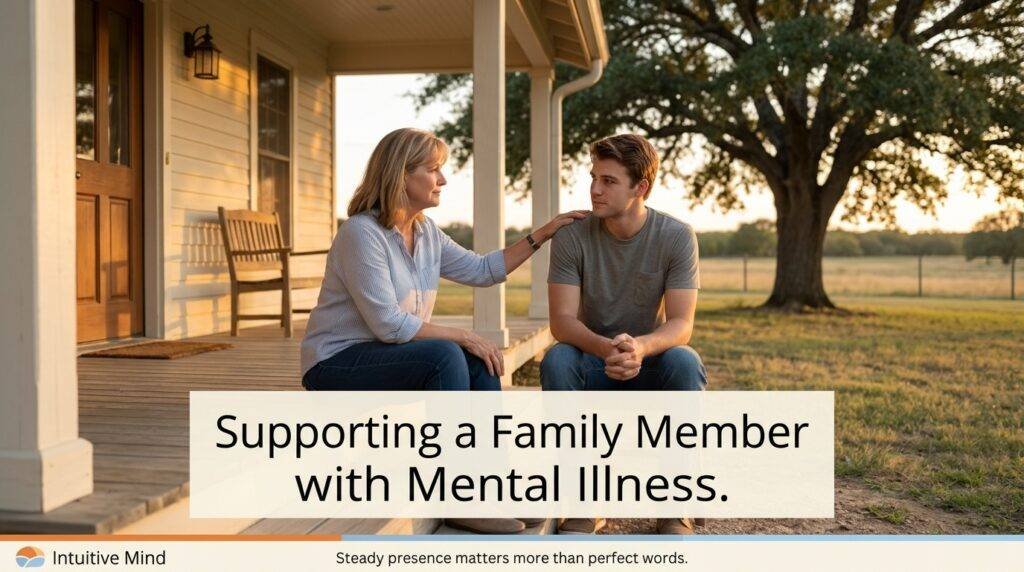
Mother sitting with her adult son on a porch, supporting a family member with mental illness

Supporting a Family Member with Mental Illness in Zorn

When Someone You Love Is Struggling Maybe it’s your son who hasn’t left his room much since he came home from school. Maybe it’s your wife, whose moods swing in ways that leave the whole household walking on eggshells. Maybe it’s your father, who’s started saying things that don’t make sense. However it shows up, supporting a family member with mental illness can be one of the hardest and most isolating things a person goes through. In a small, close-knit place like Zorn, it can feel even harder to talk about. Neighbors know each other. Families tend to handle things privately. And the idea of telling anyone what’s happening at home can feel like a betrayal of the person you’re trying to protect. So you carry it. You worry about them at night. You make excuses to relatives. You try everything you can think of: encouraging, pleading, giving space, stepping in. Some days it seems to help; other days nothing does. You may feel guilty for feeling frustrated, or exhausted in a way that sleep doesn’t fix. The holidays can bring all of this into sharper focus. Family gatherings, disrupted routines, and expectations about how everyone “should” be feeling can make symptoms worse and make the strain more visible. Here’s what’s important to know: you are not alone in this, and there are better ways forward than trying harder on your own. This guide explains what your loved one may be experiencing, why well-meant efforts sometimes backfire, what actually helps, how treatment works when families are involved, and where to turn, including in a crisis. Let’s start with understanding what’s going on. Understanding What Your Family Member Is Going Through When a family member with mental illness is struggling, the first and most useful step is understanding that their symptoms come from a health condition. Depression, bipolar disorder, schizophrenia, anxiety disorders, trauma-related conditions, and others affect how a person thinks, feels, and behaves. They are not choices, laziness, or a lack of love for you. That shift in understanding matters, because it changes how you respond. A person who isn’t getting out of bed isn’t simply refusing to try. A person who’s irritable and impulsive during a manic episode isn’t simply being selfish. A person who believes something that isn’t true isn’t simply being stubborn. The National Institute of Mental Health offers guidance on recognizing warning signs and when to get help. Signs that someone may need professional support include: When insight is limited. With some conditions, especially schizophrenia and bipolar disorder, a person may genuinely not recognize that they’re unwell. This isn’t denial in the usual sense. It can be part of the condition itself, and it’s one of the most painful challenges families face. Understanding it can help you stop taking the resistance personally. Don’t assume the worst about safety. Most people living with serious mental illness are not violent, and they’re more likely to be harmed by others than to harm anyone. At the same time, any talk of suicide or threats of harm should always be taken seriously. If it’s your child. When the person struggling is a child or teen, you have more say in their care, and early support makes a big difference. Our page on children’s mental health care covers what to look for and how evaluation works for younger patients. Only a qualified clinician can diagnose what’s going on. Your observations, though, are valuable information for that clinician, and you can share them. Why Well-Meant Efforts Sometimes Backfire Families almost always act out of love. But some of the most natural responses can unintentionally make things harder. Recognizing these patterns isn’t about blame; it’s about finding approaches that work better. Arguing with symptoms. It’s instinctive to try to talk someone out of a false belief or out of depression (“Look at everything you have to be grateful for”). But logic rarely changes symptoms, and it can leave your loved one feeling unheard or defensive. Ultimatums and pressure. “Get help or else” can feel like the only lever left. Sometimes clear boundaries are necessary. But pressure without understanding often pushes people further from treatment. Doing everything for them. Taking over every responsibility can feel like support, but it can reduce your loved one’s confidence and wear you down at the same time. Keeping it secret. Protecting privacy is important. But complete secrecy can cut both of you off from support, information, and help. Ignoring your own limits. Caregivers often push themselves until they’re exhausted, resentful, or unwell. Burnout makes it harder to stay patient and consistent, which is exactly what your loved one needs from you. [CLINICIAN’S NOTE] Two patterns we see often: debating symptoms and running on empty. Trying to argue someone out of a delusion or a depressed outlook usually increases tension without changing the symptom, and it can damage the trust you’ll need later when encouraging treatment. Meanwhile, family members who never get a break are more likely to burn out right when their loved one needs them most. Listening without arguing, and building in real support for yourself, both protect the relationship over the long run. How to Help a Family Member with Mental Illness Supporting a family member with mental illness isn’t about having the perfect words. It’s about consistent, calm presence, clear boundaries, and connecting your loved one with care that looks at the whole person. Listen first. Ask open questions, listen without interrupting, and reflect back what you hear: “It sounds like you’ve been feeling really alone.” You don’t have to agree with everything your loved one believes to acknowledge how they feel. Keep communication simple and calm. During difficult moments, short sentences, a steady voice, and fewer people in the room help. Avoid criticism, sarcasm, or bringing up past conflicts. Encourage treatment without forcing it. Focus on what your loved one cares about: sleeping better, feeling less overwhelmed, getting back to work. “Would you be willing to talk to someone about the sleep problems?”

Supporting a Family Member with Mental Illness in Zorn Read More »

Two men talking on a lake dock at sunset, a picture of openness about men's mental health

Men’s Mental Health: Breaking the Stigma in McQueeney

When “I’m Fine” Isn’t the Whole Truth Ask most men how they’re doing and you’ll hear “fine,” “busy,” or “can’t complain.” Out on Lake McQueeney on a Saturday, or at work on a Monday, it’s rarely the moment to say, “Honestly, I haven’t felt like myself in months.” That silence is a big part of why men’s mental health struggles so often go unrecognized, by friends, by family, and sometimes by the men themselves. Many men grow up learning that handling things alone is what strength looks like. You work through it. You don’t complain. You take care of everyone else. Those values have real worth. But when they mean ignoring months of exhaustion, short temper, sleepless nights, or a growing need for a few drinks to unwind, they stop protecting you and start costing you. The cost isn’t only personal. It can show up as tension at home, distance from your kids, trouble at work, or health problems that keep stacking up. Partners often notice first. They may see a man who’s more irritable, more withdrawn, or more checked out, and not know how to bring it up. Each November, men’s health gets more public attention. It’s a good moment to say plainly what many men need to hear: struggling with your mental health isn’t a character flaw, and getting help isn’t giving up. It’s the same practical decision you’d make about a knee that won’t heal or a truck that keeps stalling. This guide explains how mental health conditions often look different in men, why help gets delayed, what effective care involves, and how to take the first step without it feeling like a big production. Let’s start with what to look for. Understanding Men’s Mental Health Men’s mental health covers the same conditions anyone can experience, including depression, anxiety, trauma-related conditions, and mood disorders. What often differs is how those conditions show up and how long they go unaddressed. Many men don’t describe feeling “sad” or “anxious.” Instead, the strain comes out in behavior, the body, or relationships. The National Institute of Mental Health notes that men with depression may be more likely to experience irritability, anger, and loss of interest than sadness, which can make the condition harder to recognize. Common signs include: Anxiety in men can look like constant restlessness, trouble switching off, tension in the body, or a need to control situations. Some men experience panic attacks and mistake them for heart problems, which is understandable. New or unexplained chest pain should always be checked by a medical provider first. Trauma affects men, too, whether from military service, first-responder work, accidents, violence, or childhood experiences. It may show up as being on edge, avoiding reminders, nightmares, or emotional numbness rather than talking about what happened. The body is part of the picture. Low testosterone, thyroid problems, sleep apnea, chronic pain, and certain medications can all affect mood, energy, and motivation. These aren’t “excuses.” They’re real contributors that deserve to be checked, often alongside mental health care rather than instead of it. A word about safety. CDC data consistently show that men die by suicide at much higher rates than women, and many of those men never sought mental health care. That’s not meant to alarm you. It’s the reason it matters to take warning signs seriously, including hopelessness, feeling like a burden, or talking about not wanting to be here. Help works, and reaching out early makes a real difference. Only a qualified clinician can diagnose a mental health condition. Online quizzes can be a useful starting point, not an answer. Why Men Often Delay Getting Help Most men who eventually seek care say they waited too long. Here’s why that happens so often, and why it doesn’t have to. Stigma and self-reliance. Many men feel that admitting a mental health problem means admitting weakness. NAMI has long emphasized that stigma is one of the biggest barriers keeping people from getting care. For men, it’s often reinforced by the idea that real men handle things on their own. The symptoms don’t look like the stereotype. If depression to you means crying or staying in bed, you might not recognize it in your own anger, overwork, or drinking. Men may also see a doctor for back pain, headaches, or poor sleep and never connect those symptoms to mood. No time, no words. Between work, family, and responsibilities, mental health appointments can feel like a luxury. And many men simply haven’t had much practice putting feelings into words, which makes the first conversation feel harder than it is. Self-treatment takes over. Alcohol, staying busy, endless screens, or pushing harder at the gym can numb the edges for a while. Over time, these patterns can deepen the underlying problem and create new ones. Worry about privacy or work. Some men worry that seeking care could affect their job, their license, or how others see them. Those concerns are understandable, and they’re worth discussing openly with a provider, who can explain how your health information is protected. Care is fragmented. A primary care visit may address blood pressure or sleep. A partner may suggest counseling. No one pulls the physical, emotional, and lifestyle pieces together into one plan. [CLINICIAN’S NOTE] Two patterns we see often: waiting for a breaking point, and using alcohol to manage mood or sleep. Waiting until things fall apart, whether at home, at work, or with your health, usually means a harder road back than starting earlier would have. Relying on alcohol to unwind or sleep may feel like it helps, but it tends to worsen mood and sleep over time and can interact with medications. If you’ve been drinking more to cope, mention it at your first visit; it’s information that helps us help you, not something you’ll be judged for. A Whole-Person Approach to Men’s Mental Health Effective care for men isn’t about forcing a conversation you’re not ready for. It’s about understanding what’s really going on, setting practical goals, and

Men’s Mental Health: Breaking the Stigma in McQueeney Read More »

Woman relaxing on a lake dock at sunrise, reflecting on the link between hormones and mood

Hormones and Mood: What Every Lake Dunlap Woman Should Know

When You Don’t Feel Like Yourself Maybe it’s the week before your period, when your patience disappears and small things bring you to tears. Maybe it’s the months after having a baby, when the joy you expected feels buried under worry or numbness. Or maybe it’s your mid-40s, and you’re waking at 3 a.m., snapping at people you love, and wondering where your old self went. If any of that sounds familiar, the link between hormones and mood may be part of the story. Many women describe hearing one of two unhelpful responses. The first is “It’s just your hormones,” said in a way that suggests there’s nothing to do but wait it out. The second treats the symptoms as stress or personality, with no curiosity about why they come and go in a pattern. Both responses leave women without answers. The truth sits in between. Hormones are real biological signals that influence brain chemistry, sleep, and stress response. They can meaningfully shape how you feel. At the same time, hormones rarely act alone. Sleep, relationships, workload, past experiences, nutrition, and genetics all shape how a hormonal shift lands for you. For women in Lake Dunlap and the surrounding New Braunfels area, many of these changes happen during the busiest years of life: raising children, caring for aging parents, building careers, and keeping households running. It’s easy to put your own well-being last until it becomes impossible to ignore. This guide explains how hormonal changes at different life stages can affect mental health, why these symptoms are so often missed or misread, what effective whole-person care involves, and how to know when it’s time to talk with a professional. Let’s start with how the connection works. How Hormones and Mood Are Connected The short answer: hormones and mood are linked because reproductive hormones such as estrogen and progesterone, along with thyroid hormones and stress hormones, interact with the brain systems that regulate emotion, sleep, and energy. When those hormone levels change, especially when they change quickly, some women notice significant shifts in how they feel. Not every woman is affected the same way. Some move through hormonal transitions with little emotional change. Others are more sensitive to these shifts, and that sensitivity isn’t a weakness. It’s a biological difference that deserves attention. The Office on Women’s Health describes how hormonal changes across different life stages can affect women’s mental health. Here are the life stages and conditions where the connection most often shows up: PMS vs. PMDD. Many women experience some premenstrual moodiness. PMDD is different. It causes severe mood symptoms, such as deep sadness, intense irritability, anxiety, or feeling out of control, that reliably appear in the week or two before a period and ease soon after it starts. The symptoms are strong enough to disrupt work, relationships, or daily life. Baby blues vs. postpartum depression. Mood swings, tearfulness, and feeling overwhelmed are common in the first couple of weeks after birth and usually ease on their own. When symptoms last longer, deepen, or include persistent hopelessness, constant worry, or trouble bonding with the baby, postpartum depression or anxiety may be involved. The National Institute of Mental Health describes perinatal depression as a serious but treatable condition. The National Maternal Mental Health Hotline offers free, confidential support 24/7 by call or text at 1-833-TLC-MAMA (1-833-852-6262). Signs that need help right away. Rarely, after childbirth, a woman may experience confusion, seeing or hearing things others don’t, extreme agitation, or thoughts of harming herself or her baby. This is a medical emergency. Call 911 or 988 right away. Perimenopause is often the surprise. Many women expect hot flashes in midlife but aren’t prepared for new anxiety, irritability, or low mood, sometimes years before periods stop. The Menopause Society notes that mood changes are among the common experiences of the menopause transition. If this is where you are, our page on perimenopause and mental health goes deeper. Only a qualified clinician can tell whether symptoms are hormone-related, part of another condition, or both. Online quizzes and period apps can be helpful starting points, but not a diagnosis. Why Hormone-Related Mood Changes Are Often Missed Hormone-related mood symptoms are common, but they’re also among the most frequently dismissed or misread. Several patterns explain why. Symptoms get dismissed as “normal.” Because so many women experience some premenstrual or midlife mood change, it’s easy to assume severe symptoms are just part of being a woman. But common doesn’t mean you have to live with it. When symptoms disrupt relationships, work, or self-worth, they deserve evaluation. Or everything gets blamed on hormones. The opposite problem happens, too. Some women are told their depression or anxiety is “just hormonal” when an independent mood or anxiety disorder is also present. Hormonal sensitivity and a mental health condition can exist side by side, and each needs attention. The pattern isn’t visible in one appointment. A single visit captures one moment. If your mood shifts with your cycle, the provider may see you on a good week and miss the pattern entirely. Without symptom tracking over time, conditions like PMDD can be mistaken for bipolar disorder, depression, or anxiety, or missed altogether. Care is split between specialties. Your OB-GYN focuses on reproductive health. A therapist focuses on emotions. Your primary care provider manages everything else. Each may see a piece of the picture without anyone connecting the hormonal timeline to the mood symptoms. Women put themselves last. During the years when hormonal changes are most active, many women are caring for everyone else. Their own symptoms get pushed aside until they become overwhelming, or until someone close to them notices first. Physical look-alikes get overlooked. Thyroid problems, anemia, sleep disorders, and nutritional factors can cause fatigue, low mood, and anxiety. When these aren’t checked, a woman may be treated for the wrong thing or for only half of what’s going on. [CLINICIAN’S NOTE] Two patterns we see often: expecting hormone therapy alone to resolve mood symptoms, and not tracking

Hormones and Mood: What Every Lake Dunlap Woman Should Know Read More »

Woman relaxing on a lake dock at sunrise, reflecting on the link between hormones and mood

Hormones and Mood: What Every Lake Dunlap Woman Should Know

When You Don’t Feel Like Yourself Maybe it’s the week before your period, when your patience disappears and small things bring you to tears. Maybe it’s the months after having a baby, when the joy you expected feels buried under worry or numbness. Or maybe it’s your mid-40s, and you’re waking at 3 a.m., snapping at people you love, and wondering where your old self went. If any of that sounds familiar, the link between hormones and mood may be part of the story. Many women describe hearing one of two unhelpful responses. The first is “It’s just your hormones,” said in a way that suggests there’s nothing to do but wait it out. The second treats the symptoms as stress or personality, with no curiosity about why they come and go in a pattern. Both responses leave women without answers. The truth sits in between. Hormones are real biological signals that influence brain chemistry, sleep, and stress response. They can meaningfully shape how you feel. At the same time, hormones rarely act alone. Sleep, relationships, workload, past experiences, nutrition, and genetics all shape how a hormonal shift lands for you. For women in Lake Dunlap and the surrounding New Braunfels area, many of these changes happen during the busiest years of life: raising children, caring for aging parents, building careers, and keeping households running. It’s easy to put your own well-being last until it becomes impossible to ignore. This guide explains how hormonal changes at different life stages can affect mental health, why these symptoms are so often missed or misread, what effective whole-person care involves, and how to know when it’s time to talk with a professional. Let’s start with how the connection works. How Hormones and Mood Are Connected The short answer: hormones and mood are linked because reproductive hormones such as estrogen and progesterone, along with thyroid hormones and stress hormones, interact with the brain systems that regulate emotion, sleep, and energy. When those hormone levels change, especially when they change quickly, some women notice significant shifts in how they feel. Not every woman is affected the same way. Some move through hormonal transitions with little emotional change. Others are more sensitive to these shifts, and that sensitivity isn’t a weakness. It’s a biological difference that deserves attention. The Office on Women’s Health describes how hormonal changes across different life stages can affect women’s mental health. Here are the life stages and conditions where the connection most often shows up: PMS vs. PMDD. Many women experience some premenstrual moodiness. PMDD is different. It causes severe mood symptoms, such as deep sadness, intense irritability, anxiety, or feeling out of control, that reliably appear in the week or two before a period and ease soon after it starts. The symptoms are strong enough to disrupt work, relationships, or daily life. Baby blues vs. postpartum depression. Mood swings, tearfulness, and feeling overwhelmed are common in the first couple of weeks after birth and usually ease on their own. When symptoms last longer, deepen, or include persistent hopelessness, constant worry, or trouble bonding with the baby, postpartum depression or anxiety may be involved. The National Institute of Mental Health describes perinatal depression as a serious but treatable condition. The National Maternal Mental Health Hotline offers free, confidential support 24/7 by call or text at 1-833-TLC-MAMA (1-833-852-6262). Signs that need help right away. Rarely, after childbirth, a woman may experience confusion, seeing or hearing things others don’t, extreme agitation, or thoughts of harming herself or her baby. This is a medical emergency. Call 911 or 988 right away. Perimenopause is often the surprise. Many women expect hot flashes in midlife but aren’t prepared for new anxiety, irritability, or low mood, sometimes years before periods stop. The Menopause Society notes that mood changes are among the common experiences of the menopause transition. If this is where you are, our page on perimenopause and mental health goes deeper. Only a qualified clinician can tell whether symptoms are hormone-related, part of another condition, or both. Online quizzes and period apps can be helpful starting points, but not a diagnosis. Why Hormone-Related Mood Changes Are Often Missed Hormone-related mood symptoms are common, but they’re also among the most frequently dismissed or misread. Several patterns explain why. Symptoms get dismissed as “normal.” Because so many women experience some premenstrual or midlife mood change, it’s easy to assume severe symptoms are just part of being a woman. But common doesn’t mean you have to live with it. When symptoms disrupt relationships, work, or self-worth, they deserve evaluation. Or everything gets blamed on hormones. The opposite problem happens, too. Some women are told their depression or anxiety is “just hormonal” when an independent mood or anxiety disorder is also present. Hormonal sensitivity and a mental health condition can exist side by side, and each needs attention. The pattern isn’t visible in one appointment. A single visit captures one moment. If your mood shifts with your cycle, the provider may see you on a good week and miss the pattern entirely. Without symptom tracking over time, conditions like PMDD can be mistaken for bipolar disorder, depression, or anxiety, or missed altogether. Care is split between specialties. Your OB-GYN focuses on reproductive health. A therapist focuses on emotions. Your primary care provider manages everything else. Each may see a piece of the picture without anyone connecting the hormonal timeline to the mood symptoms. Women put themselves last. During the years when hormonal changes are most active, many women are caring for everyone else. Their own symptoms get pushed aside until they become overwhelming, or until someone close to them notices first. Physical look-alikes get overlooked. Thyroid problems, anemia, sleep disorders, and nutritional factors can cause fatigue, low mood, and anxiety. When these aren’t checked, a woman may be treated for the wrong thing or for only half of what’s going on. [CLINICIAN’S NOTE] Two patterns we see often: expecting hormone therapy alone to resolve mood symptoms, and not tracking

Hormones and Mood: What Every Lake Dunlap Woman Should Know Read More »

Adult waking rested at sunrise in a rural Texas home, showing the link between sleep and mental health

The Connection Between Sleep and Mental Health for Geronimo Residents

When a Bad Night Becomes a Pattern It’s 2:47 a.m. in Geronimo. The house is quiet, Highway 123 has gone still, and you’re wide awake again, running through tomorrow’s to-do list or replaying a conversation from last week. You already know you’ll be dragging by mid-morning. What you might not realize is how tightly sleep and mental health are tied together, and that the restless nights and the heavy days may be part of the same problem. Everyone has an occasional rough night. A sick child, a deadline, a late storm, or a too-hot summer bedroom can throw anyone off. The concern is when poor sleep stops being occasional. When it’s most nights, for weeks, and it starts to change how you feel, think, and treat the people around you, it deserves more than another cup of coffee. Many people try to solve it on their own first. They cut back on caffeine, try a sleep app, buy a new pillow, or reach for something over the counter. Those steps sometimes help. But if anxiety, depression, hormonal changes, or another underlying issue is driving the sleeplessness, surface fixes rarely hold for long. Late fall can make this harder. Shorter days, earlier darkness after the time change, and the stress of the holiday season can shift sleep and mood at the same time. For some people, that’s when a pattern that’s been building for months becomes impossible to ignore. This guide explains how sleep and mood influence each other, the signs that a sleep problem may be connected to a mental health condition, why the link is so often missed, and what effective care looks like. Let’s start with how the connection actually works. How Sleep and Mental Health Affect Each Other The short answer: sleep and mental health work in both directions. Poor sleep can make emotional symptoms worse, and mental health conditions can disrupt sleep. That two-way relationship is why the problem can feel like a loop that’s hard to break. How poor sleep affects mood. When you don’t sleep well, the brain has a harder time regulating emotions. Small frustrations feel bigger. Worry is harder to set aside. Concentration, memory, and patience drop. Over time, chronic sleep loss can make it harder to cope with ordinary stress and can deepen symptoms that were already there. The CDC recommends that most adults get at least seven hours of sleep a night and links regular short sleep to a range of health concerns, including mental distress. How mental health affects sleep. The National Institute of Mental Health lists sleep changes among the common symptoms of several mental health conditions. Sleep problems can look different depending on what’s underneath: Sleep problems that aren’t psychiatric. Not every sleep issue starts in the mind. Obstructive sleep apnea, restless legs, chronic pain, thyroid problems, certain medications, and alcohol can all disrupt sleep. Loud snoring, gasping or choking during sleep, morning headaches, or falling asleep while driving are reasons to talk with your primary care provider about a medical sleep evaluation. These conditions can also worsen mood, which is one more reason a full picture matters. A sign that needs prompt attention. For most people, sleep problems mean feeling tired. But if you or someone you love suddenly needs very little sleep, feels unusually energetic or driven, talks faster, or takes risks they normally wouldn’t, that pattern can be an early sign of a mood episode. It’s worth contacting a mental health provider promptly rather than waiting. Only a qualified clinician can tell which of these is going on, and often more than one is involved. A sleep tracker or online quiz can be a useful starting point, but not a diagnosis. Why the Sleep–Mood Link Is Often Missed Sleep problems are common enough that people tend to accept them as part of adult life. That’s one reason the link between sleep and mental health so often goes unaddressed. Sleep gets treated as a habit problem only. Good sleep habits matter, and advice about screens, caffeine, and consistent bedtimes is sound. But when someone has followed every tip and still lies awake, the issue usually isn’t willpower. Ongoing insomnia that doesn’t respond to habit changes is a signal to look deeper. Mood symptoms get blamed on being tired. The reverse happens, too. Someone feels irritable, flat, or hopeless and assumes it’s just exhaustion. Fatigue can absolutely cause those feelings. But when low mood persists even after a few good nights, or when the sleep problems started after the mood changed, depression or anxiety may be the root. Hormonal changes get dismissed. Many women in their 40s notice that sleep falls apart around the same time mood, focus, and patience start to shift. The Menopause Society notes that sleep disturbance is a common concern during the menopause transition. When night sweats, waking at 3 a.m., and new irritability show up together, perimenopause-related mood changes are worth considering rather than chalking it all up to stress. Short-term fixes become long-term habits. A nightcap, an over-the-counter sleep aid, or a long weekend nap can feel like a solution. Alcohol in particular may help you fall asleep but tends to break up sleep later in the night. Relying on any sleep aid without understanding the cause can delay the care that would actually help. Care is divided. Your primary care provider may address sleep, a therapist may address stress, and no one may connect the two. Without someone looking at the whole picture, each problem gets treated as if the other didn’t exist. [CLINICIAN’S NOTE] Two patterns we see often: treating insomnia only with sleep aids, and treating mood while ignoring sleep. Regularly relying on over-the-counter sleep products or alcohol can mask the real cause and, with some medications, create unwanted interactions. On the other side, treating anxiety or depression without paying attention to sleep can leave one of the biggest drivers of symptoms untouched. If you’ve been using something to sleep most nights, mention it to your

The Connection Between Sleep and Mental Health for Geronimo Residents Read More »

Parent comforting child on a porch before school, a calm way to ease back-to-school anxiety

Back-to-School Anxiety: Helping Laredo Kids Cope

When First-Day Nerves Become Something More It’s the night before the first day of school in Laredo. The backpack is packed, the uniform is laid out, and your child is in tears. Or they’ve gone quiet in a way that worries you. Or it’s the third night in a row they’ve said their stomach hurts. Most parents expect some jitters. What’s harder to know is when back-to-school anxiety is a passing phase and when it’s a sign your child needs more support. You may feel stuck between two instincts. One says, “Push through, they’ll be fine once they get there.” The other says, “Something is really wrong, and I don’t want to make it worse.” Both come from love, and neither one, on its own, tells you what your child actually needs. The weeks around a new school year ask a lot of kids. There are new teachers, new classrooms, new social circles, earlier mornings, and, for many children, a new campus altogether. Some kids adjust within days. Others carry the stress home, and it shows up as sleepless nights, short tempers, or a growing list of reasons to stay home. For many Laredo families, getting a child seen by a mental health specialist in person can mean a drive to San Antonio, more than two hours each way. That distance is one reason families wait, hoping things settle on their own. Sometimes they do. When they don’t, the delay can make the next school morning harder than the last. This guide is written for parents and caregivers. It explains what back-to-school worry looks like at different ages, why it’s often missed, what effective care involves, and how to decide when it’s time to talk with a professional. Let’s start with what this kind of anxiety is, and what it isn’t. Understanding Back-to-School Anxiety in Children Back-to-school anxiety is the worry, fear, or dread a child feels about returning to school or starting a new one. It usually peaks in the days before school begins and during the first few weeks of the year. For most children, it fades as routines settle in. For some, it lingers, intensifies, or spreads into other parts of life. Anxiety in children rarely announces itself as “I feel anxious.” It tends to show up in the body and in behavior. Common signs include: How it changes with age. Younger children often struggle with separation from a parent and the unfamiliarity of a new classroom. Middle schoolers tend to worry about fitting in, changing classes, and keeping up. Teenagers may feel pressure about grades, friendships, social media, and the future, and they are more likely to hide what they’re feeling. Life changes add up. A move, a new campus, a family change, or a hard previous year can all make the return to school feel heavier. For children in bilingual homes, the shift from a summer of mostly Spanish at home back to a full day of English instruction can add another layer of effort, especially for younger students. Nerves, or something more? Ordinary first-week nerves are usually short-lived and don’t stop a child from participating. Anxiety that needs attention tends to last several weeks or longer, feels out of proportion to the situation, and interferes with sleep, learning, friendships, or attendance. It also helps to look beyond anxiety itself. Trouble focusing in class can come from worry, from ADHD, or from both. A child who suddenly dreads school may be reacting to something real, such as bullying or a difficult classroom situation, which needs to be addressed directly. In teens, persistent sadness or loss of interest alongside worry can point to depression. Physical complaints deserve to be taken seriously, too. If stomachaches or headaches are new, severe, or come with fever, vomiting, or weight loss, check with your child’s pediatrician first to rule out a medical cause. Only a qualified clinician can diagnose an anxiety disorder. School screenings and online checklists are useful starting points, not answers. Why Anxiety in Kids Is Often Missed or Undertreated Most parents who eventually seek help for an anxious child say the signs were there earlier, but they didn’t look like anxiety at the time. That’s understandable. Childhood anxiety is good at disguising itself. Physical symptoms get treated as physical problems only. A child with recurring stomachaches may see the pediatrician several times, try changes to diet, or take something for nausea. Those steps are reasonable, and ruling out medical causes matters. But if no one asks what’s happening on the mornings the pain shows up, the pattern can go unrecognized for months. Behavior gets labeled instead of understood. An anxious child may refuse, argue, or melt down. To a busy adult, that can look like defiance or “overreacting.” Discipline alone rarely helps when the behavior is driven by fear, and it can leave a child feeling misunderstood. Quiet kids fall through the cracks. Some children hold it together all day at school, comply with every rule, and then fall apart the moment they get home. Teachers may see no problem at all. Parents, meanwhile, are seeing the full weight of it every evening. Families wait it out. Because some nervousness is expected, it’s easy to assume it will pass. Waiting a few weeks is often reasonable. Waiting through a whole semester while things get worse is harder to recover from. Care is split across too many places. The pediatrician sees the stomachaches. The school counselor sees the nurse visits. A therapist, if there is one, sees the child for an hour a week. Without someone pulling the full picture together, each person sees only part of it. The American Academy of Child & Adolescent Psychiatry offers family-focused guidance on anxiety and school avoidance, and a consistent theme in that guidance is early, coordinated attention rather than waiting for a crisis. [CLINICIAN’S NOTE] Two patterns we see often: letting school avoidance become routine, and treating only the symptom. Each extra day at home can bring short-term relief,

Back-to-School Anxiety: Helping Laredo Kids Cope Read More »

Skip to content