
Why Understanding the Difference Matters
If you have ever felt your heart race out of nowhere on your commute down I-10, or felt a mounting sense of dread before a high-stakes meeting in downtown San Antonio, you know how overwhelming sudden surges of fear can be.
People often use the terms “panic attack” and “anxiety attack” interchangeably. However, in psychiatric medicine, they describe distinct physiological and psychological experiences. Understanding which one you are experiencing is the first step toward getting targeted, effective relief.
Key Differences: Panic Attacks vs. Anxiety Attacks
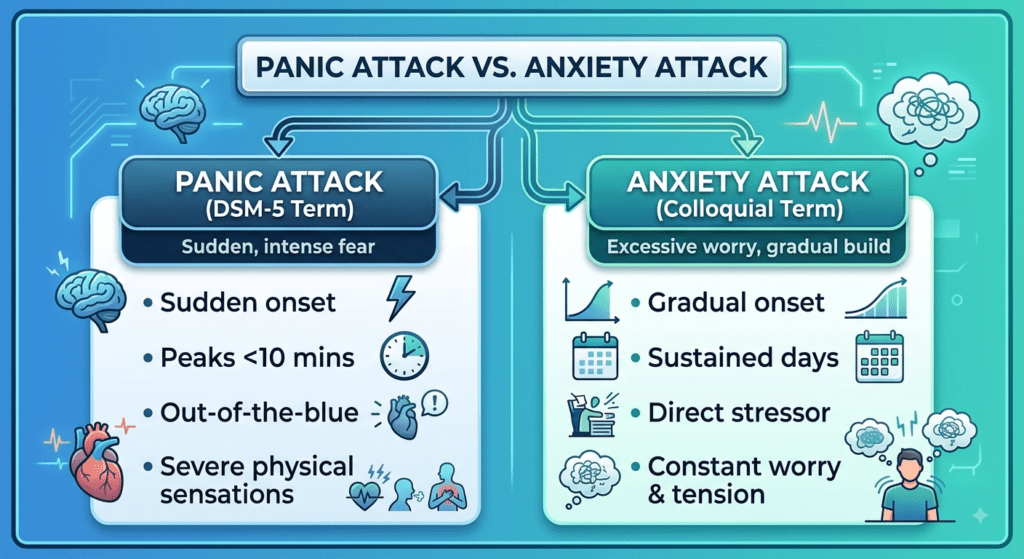
While both conditions trigger the body’s “fight-or-flight” survival response, their timing, intensity, and underlying mechanisms differ significantly.
1. Onset and Peak Intensity
- Panic Attacks: Strike suddenly and fiercely, like a sudden thunderstorm. Intensity usually peaks within 10 minutes before slowly subsiding over 20 to 30 minutes.
- Anxiety “Attacks”: Build incrementally over hours, days, or weeks. The distress fluctuates in intensity and can linger as a persistent state of hyperarousal.
2. Presence of a Trigger
- Panic Attacks: Can occur completely unprovoked (uncued)—waking you from sleep (nocturnal panic) or striking during a calm, relaxing moment.
- Anxiety “Attacks”: Are almost always tied to a perceived threat or chronic stressor, such as financial stress, health concerns, work pressure, or relationship conflict.
3. Diagnostic Recognition
- Panic Attacks: A recognized clinical entity in the Diagnostic and Statistical Manual of Mental Disorders (DSM-5-TR), either as a standalone specifier or as part of Panic Disorder.
- Anxiety “Attacks”: Not a formal clinical diagnosis. Clinicians usually categorize persistent, building anxiety under Generalized Anxiety Disorder (GAD), Social Anxiety Disorder, or specific phobias.
Direct Symptom Comparison
| Feature / Symptom | Panic Attack | Severe Anxiety Episode |
| Clinical DSM Status | Formal specifier / diagnosis | Informal / descriptive term |
| Speed of Onset | Abrupt (0 to peak in minutes) | Gradual (builds over hours/days) |
| Duration | 20–30 minutes average | Hours, days, or weeks |
| Heart Palpitations / Racing Heart | Severe, pounding, rapid | Moderate, steady elevation |
| Shortness of Breath / Smothering | Intense; feels like suffocation | Mild to moderate chest tightness |
| Sense of Impending Doom | Terror; feeling like dying or going crazy | Dread; worrying about future outcomes |
| Physical Tension | Trembling, shaking, numbness, chills | Chronic muscle stiffness, jaw clenching |
| Gastrointestinal Distress | Sudden nausea or abdominal cramping | Persistent “knot” in stomach, IBS symptoms |
The Neurobiology of Panic and Anxiety
Both panic and anxiety stem from an overactive nervous system, but they engage different brain pathways and biological cascades:
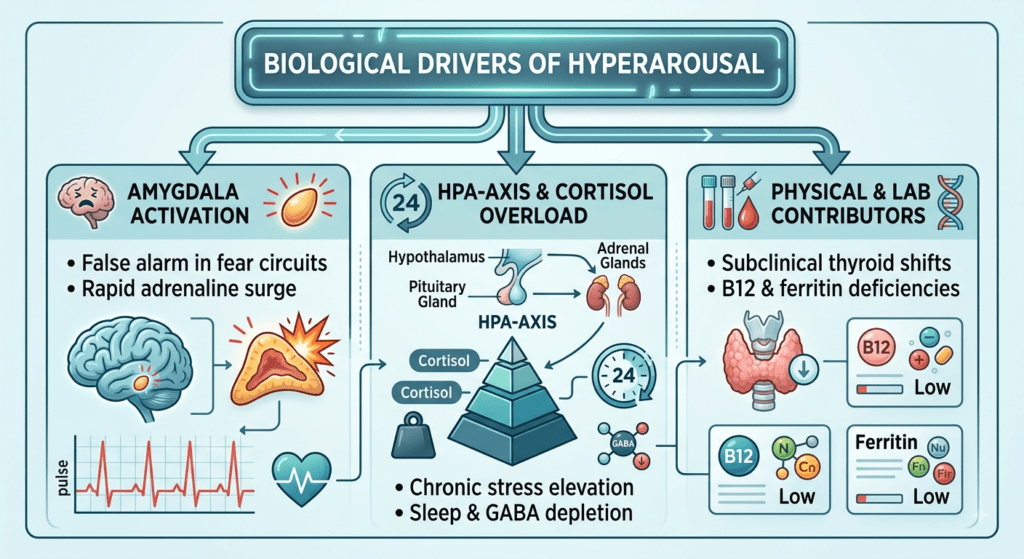
When a panic attack hits, the brain’s alarm system (the amygdala) triggers a massive, sudden release of adrenaline and noradrenaline, accelerating heart rate and altering respiration instantly.
In chronic anxiety, the hypothalamic-pituitary-adrenal (HPA) axis remains chronically activated, leaking elevated levels of cortisol into your bloodstream. Over time, this exhausts your adrenal system, disrupts neurotransmitters (like GABA and serotonin), and impairs sleep quality.
To explore how anxiety and panic relate to other mood conditions, view our dedicated pages for anxiety care services, depression care, and mood disorder treatment.
Traditional vs. Integrative Psychiatric Evaluation
Many standard medical clinics offer quick symptom-matching during 15-minute visits, resulting in immediate prescriptions without investigating why your nervous system is stuck in overdrive.
At Intuitive Mind Behavioral Health, located just north of San Antonio in New Braunfels, we utilize a comprehensive, whole-person approach that investigates both biological and environmental triggers.
During your 90-minute initial evaluation, we review your full medical history, sleep patterns, stress exposure, and nutrient status. We order functional blood work to evaluate thyroid function, iron stores (ferritin), vitamin D, and B-complex levels—all of which can mimic or exacerbate panic symptoms when depleted.
When medication is appropriate, we offer GeneSight® pharmacogenomic testing to analyze how your specific DNA metabolizes psychiatric medications, minimizing side effects and improving treatment outcomes.
“Panic and anxiety are not signs of weakness—they are signal flares from an overworked, dysregulated nervous system that deserves thorough, root-cause care.”
— Lydia Kimeli-Pope, MSN, PMHNP-BC
Immediate Coping Strategies vs. Long-Term Solutions
When panic or acute anxiety strikes, immediate somatic grounding techniques help signal safety to your brain.
| Objective | Grounding Technique | Physiological Impact |
| In the Moment (Panic) | 4-7-8 Breathing: Inhale for 4s, hold for 7s, exhale slowly for 8s. | Stimulates the vagus nerve to slow heart rate and lower adrenaline. |
| In the Moment (Anxiety) | 5-4-3-2-1 Sensory Reset: Identify 5 things you see, 4 you feel, 3 hear, 2 smell, 1 taste. | Shifts neural activity from emotional fear centers to the prefrontal cortex. |
| Long-Term Reset | Sub-Diaphragmatic Pacing: Daily 10-minute breathwork & morning sunlight. | Resets circadian cortisol rhythms and increases GABA production. |
| Root-Cause Relief | Integrative Evaluation: Comprehensive lab work and guided psychiatric care. | Identifies cellular, hormonal, and neurochemical imbalances. |
Learn more about our clinical practice approach on our about page and review our specialized services for bipolar disorder care.
“You do not have to live in fear of your next panic attack. With the right biological and somatic tools, you can retrain your nervous system to feel calm and secure.”
— Lydia Kimeli-Pope, MSN, PMHNP-BC
If you are experiencing an acute mental health crisis, immediate help is available. Contact the 988 Suicide & Crisis Lifeline by calling or texting 988 for free, confidential, 24/7 support.
For additional clinical educational resources on anxiety disorders and panic conditions, visit the National Institute of Mental Health (NIMH) or the Substance Abuse and Mental Health Services Administration (SAMHSA).
Why San Antonio & Hill Country Patients Choose Intuitive Mind
Intuitive Mind Behavioral Health is led by Lydia Kimeli-Pope, MSN, PMHNP-BC—a Board-Certified Psychiatric Mental Health Nurse Practitioner specializing in integrative, root-cause psychiatric care.
Serving patients across San Antonio, Stone Oak, Alamo Heights, Schertz, Cibolo, and New Braunfels, our practice provides a comfortable, unhurried space for healing. Reach out via our contact page to begin.
Step-by-Step Pathway to Relief
Getting starting with personalized, whole-person psychiatric care is simple and clear.
- Free 15-Minute Consultation: A brief, confidential call to discuss your symptoms and ensure our integrative model aligns with your needs.
- Pre-Visit Digital Intake: Complete comprehensive health histories, symptom trackers, and lifestyle logs online prior to your appointment.
- 90-Minute Deep-Dive Intake: An unhurried session (in-person or telehealth) covering your physical health, medical history, stress factors, and goals.
- Targeted Lab Work & Testing: Ordering functional blood panels and GeneSight® pharmacogenomics as clinically recommended.
- Personalized Care Plan: Crafting a tailored plan integrating somatic tools, targeted nutrient support, lifestyle adjustments, and precision medication management.
Reclaim Peace and Nervous System Control Today
You don’t have to navigate overwhelming panic or relentless anxiety alone. Lasting peace of mind and nervous system stability are within reach.
Take the first step toward personalized care today:
- Primary Action: Book a Free 15-Minute Consult
- Direct Phone: Call our team at (830) 302-4097
- Explore Services: Learn more about our anxiety care services
We proudly support patients across San Antonio, New Braunfels, Schertz, Cibolo, Boerne, and across Texas via telehealth. Let us help you rebuild lasting calm and resilience.
This content is educational and does not substitute for formal medical or clinical evaluation. Always consult a licensed healthcare provider regarding physical or psychological symptoms.
About the Author
Intuitive Mind Behavioral Health — Lydia Kimeli-Pope, MSN, PMHNP-BC
Board-Certified Psychiatric Mental Health Nurse Practitioner
Intuitive Mind Behavioral Health is an integrative psychiatric practice located in New Braunfels, Texas, serving adults, young adults, and families across San Antonio, Bexar County, Comal County, and statewide via telehealth across Texas and New Mexico. We pair evidence-based psychiatric medicine with functional lab testing, nutritional wellness, and pharmacogenomic precision care.
📍 387 W. Mill St. Suite 106, New Braunfels, TX 78130
Accepting new patients. Free 15-minute consultations available.