
When Worry Starts Running the Show
Your heart is pounding before a meeting that hasn’t started yet. You’re lying awake replaying a conversation from three days ago. You skip a gathering with friends because the thought of it makes your chest tight. Everyone feels anxious sometimes, but when worry starts shaping your choices, your sleep, and your days, it helps to have practical tools. Learning coping skills for anxiety gives you ways to calm your body, steady your thoughts, and take back some control.
Anxiety is a normal human response. It’s the body’s alarm system, designed to keep you alert and safe. The problem comes when that alarm goes off too often, too strongly, or in situations that aren’t actually dangerous. Then it can feel like your own body is working against you.
For many people around Hunter and the corridor between New Braunfels and San Marcos, life moves fast: long commutes, demanding jobs, family responsibilities, and little time to slow down. It’s easy to push anxiety aside until it shows up as tension headaches, short tempers, poor sleep, or a sense of dread that won’t lift.
The good news is that anxiety responds well to practice. The same brain that learned to be on high alert can learn to settle, especially with the right tools and, when needed, the right support.
This guide walks through practical, research-informed coping skills for the body and mind, habits that make anxiety worse, how to build skills into daily life, and when it’s time to seek professional help. Let’s start with what anxiety actually does.
Understanding What Anxiety Does to You
Anxiety affects three connected systems: your body, your thoughts, and your behavior. Understanding all three makes coping skills easier to use.
In the body. When your brain senses a threat, it triggers the fight-or-flight response. Your heart beats faster, breathing gets quicker and shallower, muscles tense, and digestion slows. You might feel shaky, dizzy, sweaty, or nauseated.
In your thoughts. Anxious thinking tends to focus on what could go wrong. Common patterns include imagining the worst outcome, overestimating danger, underestimating your ability to cope, and getting stuck in “what if” loops.
In your behavior. Anxiety pushes you to escape or avoid whatever feels threatening. You might cancel plans, procrastinate, seek constant reassurance, or overprepare.
These three systems feed each other. A racing heart makes anxious thoughts feel more believable. Anxious thoughts make you want to avoid. Avoidance keeps the brain convinced that the situation was dangerous. Coping skills work by interrupting this cycle at any point.
When anxiety may be more than everyday stress. The National Institute of Mental Health describes anxiety disorders as conditions in which anxiety doesn’t go away, can get worse over time, and interferes with daily activities like work, school, and relationships. Common types include generalized anxiety disorder, panic disorder, and social anxiety disorder.
A note about physical symptoms. Chest pain, shortness of breath, or a racing heart can come from anxiety, but they can also signal a medical problem. If you have new or unexplained chest symptoms, get checked by a medical provider first.
Only a qualified clinician can diagnose an anxiety disorder.
Habits That Make Anxiety Worse
Before learning what helps, it’s worth knowing what tends to make anxiety stronger. Many of these habits feel helpful in the moment, which is exactly why they’re easy to fall into.
Avoidance. Skipping the situations that make you anxious brings quick relief. But each time you avoid, your brain learns that the situation was dangerous and that you couldn’t have handled it. Over time, the list of things you avoid tends to grow.
Reassurance-seeking. Asking others “Are you sure it’s okay?” or repeatedly searching online for answers can calm you briefly, but the doubt usually returns, often stronger.
Too much caffeine. Caffeine can produce physical sensations that feel like anxiety: a racing heart, jitteriness, and restlessness.
Alcohol as a coping tool. Alcohol may take the edge off in the moment, but it can disrupt sleep and lead to more anxiety the next day.
Constant screen time and news. Scrolling late at night or checking the news repeatedly can keep your nervous system on alert and cut into sleep.
Poor sleep. Short or broken sleep makes the brain more reactive to stress and anxiety the next day.
[CLINICIAN’S NOTE] Two patterns we see often: avoiding anxiety triggers and using coping skills only in emergencies. Avoidance feels like protection, but it usually teaches the brain to fear more situations, not fewer. And skills like slow breathing or grounding work far better when they’ve been practiced on calm days, so they’re familiar when anxiety spikes. Think of coping skills like any other skill: they get stronger with regular use.
Coping Skills for Anxiety That Actually Help
Coping skills for anxiety are practical strategies you can use to calm your body, manage anxious thoughts, and face situations instead of avoiding them. No single skill works for everyone, so it helps to try several and keep the ones that fit.
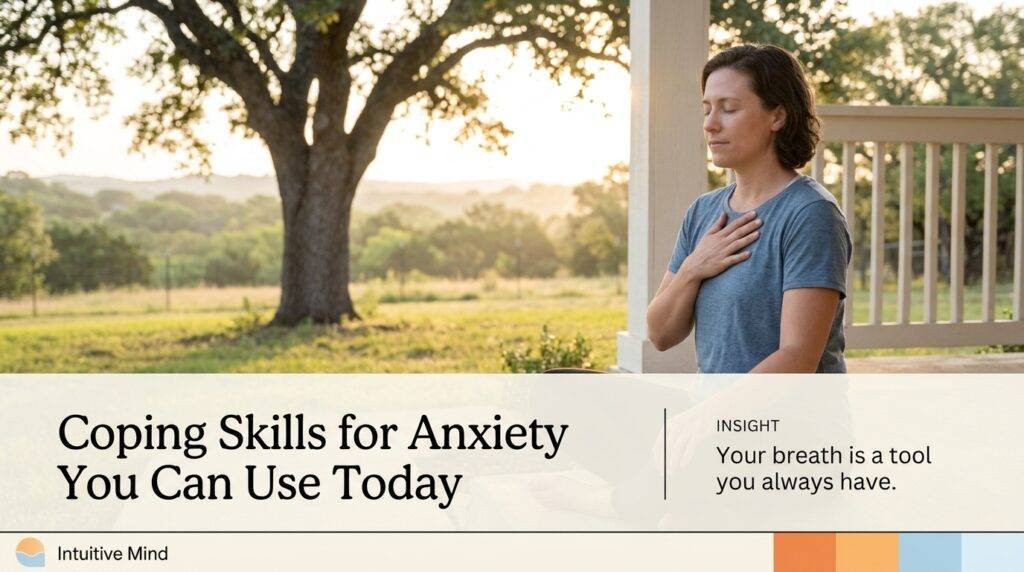
Slow, paced breathing. When anxious, breathing becomes fast and shallow. Slowing your breath, especially making the exhale longer than the inhale, signals your body that it’s safe to settle. Try breathing in gently through your nose for a slow count of four, then out through your mouth for a slow count of six. Repeat for a few minutes. If counting makes you more anxious, simply focus on making each breath out a little longer.
Grounding with your senses. Grounding pulls your attention away from anxious thoughts and back to the present moment. One popular version is the 5-4-3-2-1 technique:
- Notice 5 things you can see
- Notice 4 things you can feel, like your feet on the floor
- Notice 3 things you can hear
- Notice 2 things you can smell
- Notice 1 thing you can taste
Progressive muscle relaxation. Anxiety often lives in your muscles. Working from your feet up to your face, tense one muscle group for a few seconds, then release it and notice the difference. This builds awareness of tension and teaches your body how to let it go.
Scheduled worry time. If worries follow you all day, try setting aside a short, specific time each day, such as 15 minutes in the late afternoon, to write them down and think them through. When a worry pops up at other times, jot it down and save it for later. Many people find this shrinks the space worry takes up.
Checking anxious thoughts. When you notice an anxious thought, pause and ask: What’s the evidence for and against this? What would I tell a friend who had this worry? What’s the most likely outcome, not just the worst one? This skill comes from cognitive behavioral therapy, which the American Psychiatric Association describes as an effective treatment for anxiety disorders.
Facing fears gradually. Instead of avoiding what makes you anxious, take small, manageable steps toward it. If driving on the highway feels impossible, start with short drives on quieter roads. Each step teaches your brain that you can handle more than it thought. This works best when steps are gradual and planned.
Moving your body. Physical activity helps burn off stress hormones and often improves mood and sleep. A walk outside, a bike ride, or time on the water can all help. Regular movement tends to matter more than intensity.
Protecting sleep. A consistent sleep schedule, a wind-down routine, limiting screens before bed, and cutting back on late-day caffeine all support a calmer nervous system.
Staying connected. Talking with someone you trust, spending time with friends, or joining a group activity can ease anxiety and counter the pull toward isolation.
When skills aren’t enough. Coping skills are powerful, but they’re not a substitute for treatment when anxiety is persistent or severe. Structured therapy, and sometimes medication, can make a meaningful difference. Learn more about our approach to anxiety and panic treatment.
When anxiety and low mood overlap. Anxiety and depression often occur together. If you’re also feeling flat, hopeless, or uninterested in things you used to enjoy, it’s worth addressing both. See how we approach depression treatment.
Teaching kids these skills. Children can learn many of the same skills, especially breathing, grounding, and facing fears step by step, with parents coaching along the way. Our page on children’s mental health care explains how we support anxious kids and their families.
Anxiety convinces people that the only way to feel safe is to avoid, escape, or control everything. Coping skills prove otherwise, one small experience at a time. When those skills are paired with the right support, people stop organizing their lives around fear and start living with more freedom.
When to Seek Professional Help
Coping skills help many people manage everyday anxiety. But sometimes anxiety needs more support. Consider reaching out to a professional if:
- Anxiety lasts for weeks or months and doesn’t improve with self-help
- It interferes with work, school, relationships, or daily tasks
- You’re avoiding more and more situations
- You experience panic attacks or intense physical symptoms
- You’re relying on alcohol or other substances to cope
- You’re having thoughts of hopelessness or self-harm
What professional care can add. A comprehensive psychiatric evaluation looks at symptoms, sleep, health, medications, substance use, and life stressors to understand what’s driving your anxiety. Treatment may include structured therapy, medication when appropriate, and lifestyle support. Functional and hormonal lab testing may be recommended when symptoms suggest a physical contributor, such as thyroid problems. When medication is being considered, pharmacogenomic testing may provide information about how your genes could affect your response to certain medications. It doesn’t guarantee the right medication, but it can help guide choices.
NAMI notes that anxiety disorders are among the most common mental health conditions and that they’re highly treatable.
Comparing Your Options
Here’s how common approaches to anxiety compare.
| Care Option | What It Addresses | Often a Good Fit When | Limitations to Know |
|---|---|---|---|
| Self-help coping skills | Everyday anxiety, stress, physical tension | Anxiety is mild or occasional | May not be enough for persistent or severe anxiety |
| Apps and online programs | Guided practice, skill-building | You want structure for practicing on your own | Quality varies; not personalized |
| Avoidance and reassurance | Short-term relief | Not recommended as a strategy | Tends to make anxiety stronger over time |
| Therapy (such as CBT) | Thought patterns, avoidance, coping skills | Anxiety is moderate to severe or persistent | Requires regular practice and commitment |
| Medication only | Symptom intensity | Prescribed with regular follow-up | Often works best alongside therapy and skills |
| Integrated psychiatric care (Intuitive Mind approach) | Evaluation, therapy, medication when appropriate, labs, lifestyle, coordination | Anxiety is persistent, affects daily life, or overlaps with other conditions | Requires an evaluation first; plan and pace depend on the individual |
A practical way to use this table: if your anxiety is mild or occasional, start practicing coping skills daily. If it lasts for weeks, keeps growing, or interferes with your life, a professional evaluation is a reasonable next step.
What to Expect at Intuitive Mind
For residents of Hunter, our New Braunfels office is a short drive, and telehealth is available anywhere in Texas. If you spend more of your time in San Marcos, our page on mental health care for the San Marcos area has more information.
Initial Evaluation. We start with a conversation about what your anxiety looks like, when it started, how it affects your life, and what you’ve already tried. It helps to bring a list of current medications and supplements, any recent lab results, and a few notes about when anxiety tends to show up. We handle the assessment and explain what we see in plain language.
Personalized Plan. Together, we build a plan that may include therapy, practical coping skills, lab work, lifestyle changes, or a discussion of medication. You’ll understand what each step is for. Your role is to share what feels realistic.
Ongoing Care. Follow-up visits track how anxiety is changing, which skills are working, and whether the plan needs adjusting.
Adjust and Coordinate. As things improve or change, the plan changes too. With your consent, we coordinate with your primary care provider, therapist, or other clinicians so your care stays connected.
Every person’s experience with anxiety is different, and the pace of progress varies from person to person.
Common Questions About Managing Anxiety
Do coping skills for anxiety really work?
For many people, yes. Breathing, grounding, challenging anxious thoughts, and facing fears gradually are all based on approaches used in effective anxiety treatment. They tend to work best with regular practice. If anxiety stays severe or keeps interfering with daily life, professional treatment can add structure and support.
How can I calm a panic attack?
Panic attacks feel frightening but usually peak and pass within minutes. Slow your breathing, especially the exhale, and use grounding to focus on your surroundings. Remind yourself that the feeling will pass. If you have new or unexplained chest pain or symptoms that don’t ease, seek medical care right away.
When should I see a professional about anxiety?
Consider an evaluation if anxiety lasts for weeks or months, interferes with work, school, or relationships, leads you to avoid more and more situations, or comes with panic attacks, substance use, or thoughts of self-harm. Earlier care is often easier than waiting until things get worse.
Does insurance cover anxiety treatment?
We work with many major insurance plans and also offer self-pay. Contact us to confirm coverage. It can help to check your plan’s mental health benefits before your first appointment.
Your Next Step Is a Conversation
Anxiety can feel overwhelming, but it’s one of the most treatable mental health concerns. Practicing coping skills for anxiety gives you tools to steady yourself in hard moments, and the right support can help you build lasting change.
The most useful next step isn’t waiting for anxiety to go away on its own. If it’s affecting your life, it’s a comprehensive evaluation that helps you understand what’s driving your anxiety before deciding what to change.
- Ready to start? Book an evaluation with Intuitive Mind. In-person visits are available in New Braunfels, with telehealth anywhere in Texas.
- Prefer to talk first? Call us at (830) 302-4097 with your questions.
- Want to learn more? Read about how we treat anxiety, panic, and worry.
If you’re in crisis or thinking about harming yourself, you don’t have to wait for an appointment. Call or text 988 to reach the 988 Suicide & Crisis Lifeline, available 24/7. In Comal County, the Hill Country MHDD 24-hour crisis line is 1-877-466-0660. If you or someone else is in immediate danger, call 911 or go to the nearest emergency room. Intuitive Mind is not an emergency service.
About This Article
Written by the Intuitive Mind Behavioral Health Care Team Clinically reviewed by Lydia Kimeli-Pope, MSN, PMHNP
Intuitive Mind Behavioral Health is a psychiatric mental health practice based in New Braunfels, Texas, offering whole-person care for adults, children, and families, in person and through telehealth across Texas and New Mexico. Our approach combines psychiatric evaluation, therapy, medication management, pharmacogenomic testing, functional and hormonal lab testing, and nutritional and lifestyle support.
🌐 intuitive-mind.com 📍 387 W. Mill St. Suite 106, New Braunfels, TX 78130 📞 (830) 302-4097