
When the Nearest Specialist Feels Too Far Away
Your daughter’s anxiety has been building since school started. Your husband hasn’t been sleeping, and his patience is gone. Or maybe it’s you: months of feeling flat and worn out, and a growing sense that you need more help than your primary care provider can offer. You’ve thought about seeing a psychiatric specialist, but the waitlists are long, the drive to San Antonio takes more than two hours each way, and missing work or school for a single appointment feels impossible. For many families, telehealth psychiatric care changes that equation.
Laredo is a large, growing city, but specialized mental health care can still be hard to reach. Families often juggle work schedules, school pickups, caregiving for relatives, and the reality that even a short appointment can take most of a day once travel and waiting room time are added up.
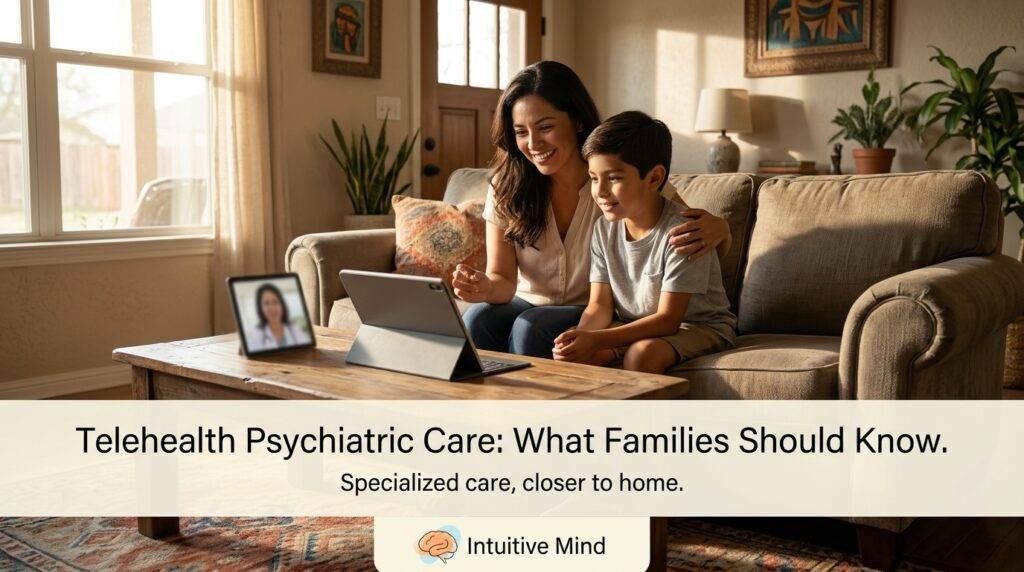
Telehealth has made a real difference for many families across Texas. Video visits let you meet with a psychiatric provider from your living room, your car during a lunch break, or a quiet room at work. For children and teens, it can mean fewer missed school days and less stress for everyone.
Still, many parents have honest questions. Does a video visit work as well as an in-person one? Is it private? What about medications, lab work, or a child who won’t sit still in front of a screen? What happens in an emergency?
This guide answers those questions. It explains what telehealth psychiatry is, what it treats well, where its limits are, how visits work for children and adults, and how to get started. Let’s begin with the basics.

What Telehealth Psychiatric Care Is and What It Treats
Telehealth psychiatric care is mental health care delivered by secure video, and sometimes phone, instead of in an office. A psychiatric provider, such as a psychiatrist or psychiatric mental health nurse practitioner, conducts evaluations, makes diagnoses when appropriate, manages medications, and coordinates treatment, all without you needing to travel.
The National Institute of Mental Health notes that telemental health can expand access to care, especially for people in areas with fewer providers or who face barriers like transportation and scheduling.
Telehealth commonly supports care for:
- Anxiety and panic: worry, physical anxiety symptoms, and avoidance
- Depression and mood disorders: low mood, loss of interest, mood swings
- ADHD: evaluation and ongoing management for children, teens, and adults
- Trauma and stress: sleep problems, nightmares, feeling on edge
- Children’s emotional and behavioral concerns: with parents participating directly
- Medication management: follow-ups, side effect reviews, and adjustments
What a visit includes. A telehealth evaluation covers the same core questions as an in-person visit: symptoms, history, sleep, appetite, school or work, family history, physical health, and current medications. Providers can also observe mood, speech, and behavior on video, which is a meaningful part of a psychiatric assessment.
What it can’t do as well. Telehealth isn’t designed for emergencies. Some situations need in-person care, such as a physical exam for a new medical symptom, a high level of support for severe symptoms, or a crisis that requires immediate safety measures. Lab work, when needed, is usually done at a local lab, with results sent to your provider.
A note on medications. Many psychiatric medications can be prescribed through telehealth. Federal rules for prescribing certain controlled medications by telehealth, including some ADHD medications, have been changing in recent years. Your provider will explain the current requirements for your situation.
Only a qualified clinician can diagnose a mental health condition or recommend treatment.
Common Concerns, and What Families Should Know
Many families hesitate to try telehealth because of reasonable questions. Here’s what tends to come up most.
“Will it really work over video?” For many conditions, research and clinical experience suggest that telehealth can be effective for evaluation and ongoing care. Some people even find it easier to open up from the comfort of home. If a provider believes in-person care is needed for part of your treatment, they should tell you.
“Is it private?” Reputable practices use secure video platforms designed for health care. On your end, privacy depends on finding a quiet space where others can’t overhear. Headphones help in busy households.
“My child won’t sit still.” That’s normal, and it’s useful information. Providers who work with children expect movement, distraction, and short attention spans. Parents often provide much of the history, and younger children may join for part of the visit rather than all of it.
“We don’t have great internet.” A stable connection matters. Connecting from a place with a strong signal, closing other apps, and testing your device before the visit help a lot. Ask your provider’s office what options are available if video doesn’t work during a visit.
“What if it’s an emergency?” Telehealth isn’t emergency care. If someone is in danger, call 911. For a mental health crisis, call or text 988 or call the local crisis line. Knowing these numbers in advance is part of being prepared.
“Can we get help in Spanish?” Many Laredo families are bilingual or prefer Spanish for health conversations. Ask about language options when scheduling. The 988 Suicide & Crisis Lifeline offers support in Spanish.
[CLINICIAN’S NOTE] Two patterns we see often: treating telehealth as a substitute for crisis care, and joining visits from a place where you can’t speak freely. A scheduled video visit isn’t the right place to handle an active emergency; call 911, 988, or your local crisis line first. And when visits happen in a crowded kitchen or a car with kids in the back seat, people tend to hold back what matters most. Planning a private, quiet spot before each visit makes care more effective, especially for teens, who often need some time to talk without a parent in the room.
How Telehealth Care Works for Families
Telehealth isn’t just a convenient version of an office visit. Done well, it supports the same whole-person approach to care, with some advantages for busy families.
A comprehensive evaluation comes first. The first visit is usually the longest. For children and teens, parents share history, school concerns, and what they’ve noticed at home, and the provider spends time with the child or teen as appropriate for their age. For adults, the evaluation covers symptoms, history, health, medications, and goals. Our page on children’s mental health care explains how evaluations work for younger patients.
Parent guidance is built in. Much of helping a child with anxiety, ADHD, or behavior challenges involves coaching parents on routines, responses, and school supports. Telehealth makes it easier for both parents, or a grandparent who helps with care, to join from different locations.
Evaluation and care for attention concerns. ADHD evaluations often involve parent and teacher input, rating scales, and observation over time. Much of this can be gathered virtually, with follow-up visits tracking how school and home are going. Learn more about our ADHD evaluation and care.
Treating anxiety from a familiar place. For anxious children and adults, starting care at home can lower the barrier to that first conversation. Therapy skills can be practiced in the same environment where anxiety shows up. See how we approach anxiety and panic treatment.
Medication management. Follow-up visits for medication are often shorter and work especially well by video. Your provider reviews how symptoms are changing, checks for side effects, and adjusts the plan. When medication is being considered, pharmacogenomic testing may provide information about how your genes could affect your response to certain medications. It doesn’t guarantee the right medication, but it can help guide choices.
Lab testing when needed. Functional and hormonal lab testing may be recommended when symptoms suggest a physical contributor, such as thyroid problems or nutritional deficiencies. Labs are typically drawn at a lab near you, so you don’t have to travel far.
Coordination with local providers. With your consent, your telehealth provider can coordinate with your child’s pediatrician, your primary care provider, a local therapist, or school staff. That keeps care connected even when your providers are in different places. It also means your child’s pediatrician or school counselor can stay informed about the plan and reinforce it between visits.
Preparing for each visit. A little preparation makes video visits more productive. Before each appointment, jot down what has changed since the last visit: sleep, mood, school or work, side effects, and any questions. Keep a current medication list nearby. For children’s visits, it helps to have a calm activity ready for younger siblings and to let teachers’ notes or report cards be part of the conversation. These small steps help your provider see the full picture in the time you have.
Consistency over time. Because visits don’t require travel, families are often able to keep follow-up appointments more consistently, which matters for tracking progress and adjusting treatment.
How progress is measured. Success looks like better sleep, steadier mood, improved focus, smoother school mornings, fewer conflicts at home, and family members feeling more like themselves, tracked over time with you.
For many families, the hardest part of mental health care isn’t the treatment; it’s getting to the appointment. Telehealth removes much of that barrier while keeping what matters most: a thorough evaluation, a personalized plan, and someone paying attention over time. When care fits into a family’s real life, families are far more likely to stay with it.
Comparing Your Care Options
Here’s how common options compare for Laredo families considering psychiatric care.
| Care Option | What It Addresses | Often a Good Fit When | Limitations to Know |
|---|---|---|---|
| Primary care or pediatrician | Physical health, initial screening, some medications | Symptoms are mild or a first step is needed | Limited time for complex psychiatric care |
| School counseling | School-based stress and adjustment | Concerns are mainly at school | Can’t diagnose or prescribe |
| Local in-person psychiatric care | Evaluation, diagnosis, medication management | A local provider is available with reasonable wait times | Availability, wait times, and travel vary |
| Travel to a larger city for specialty care | Specialized evaluation | A specific in-person service is needed | Time, cost, and missed work or school |
| Telehealth psychiatry (Intuitive Mind approach) | Evaluation, medication management, parent guidance, labs, coordination | You want specialized care without long travel | Not for emergencies; some needs require in-person care |
| Crisis services (988, local crisis line, 911) | Immediate safety and urgent support | Someone may be in danger or symptoms are escalating | For emergencies, not ongoing treatment |
The CDC notes that mental health conditions often begin in childhood, which is one reason early access to care matters. The American Academy of Child & Adolescent Psychiatry has also published guidance on using telepsychiatry with children and adolescents.
A practical way to use this table: if symptoms are mild, starting with your child’s pediatrician or your primary care provider is reasonable. If symptoms persist, are affecting school, work, or family life, or involve medication questions, a psychiatric evaluation, by telehealth or in person, is a reasonable next step.
What to Expect at Intuitive Mind
We provide telehealth care to patients located anywhere in Texas, including Laredo. Our office is in New Braunfels, for families who ever want to come in person.
Initial Evaluation. Your first visit is a thorough video conversation about symptoms, history, health, and goals. For children, a parent or guardian participates. It helps to bring a list of medications and supplements, recent lab results or records, school reports or teacher notes if relevant, and a few notes on what you’ve noticed. Test your device and connection beforehand, and choose a private spot. We handle the assessment and explain what we see in plain language.
Personalized Plan. Together, we build a plan that may include therapy, medication when appropriate, lab work, lifestyle steps, and parent guidance. You’ll know what each step is for. Your role is to share what’s realistic for your family’s schedule.
Ongoing Care. Follow-up telehealth visits track progress and adjust the plan. Many families find it easier to keep these appointments because there’s no travel.
Adjust and Coordinate. As needs change, the plan changes. With your consent, we coordinate with local pediatricians, primary care providers, therapists, or schools so care stays connected.
Every family is different, and the pace of progress varies from person to person.
Common Questions About Telehealth Psychiatric Care
Is telehealth as effective as in-person psychiatric care?
For many conditions, including anxiety, depression, and ADHD, telehealth can be an effective way to receive evaluation and ongoing care. Some situations still call for in-person care, such as emergencies or certain medical needs. Your provider will let you know if an in-person visit or a different level of care is recommended.
Can my child be seen through telehealth?
Yes. Children and teens can be seen through telehealth with a parent or guardian participating. Visits are adapted to the child’s age; younger children may join for part of the visit, while teens often have some time to speak privately. Contact us about the age ranges we see.
What do I need for a telehealth visit?
You’ll need a smartphone, tablet, or computer with a camera and microphone, a reliable internet connection, and a private, quiet space. Headphones can help with privacy. Testing your device and connection before the visit helps things go smoothly.
Does insurance cover telehealth visits?
Many insurance plans cover telehealth mental health visits. We work with many major insurance plans and also offer self-pay. Contact us to confirm coverage, and check your plan’s mental health and telehealth benefits before your first appointment.
Your Next Step Is a Conversation
Distance, schedules, and long waitlists shouldn’t stand between your family and the care you need. Telehealth psychiatric care brings thorough evaluations, personalized plans, and ongoing support into your home, while keeping care connected to the people and places already part of your family’s life.
The most useful next step isn’t waiting for a local opening or planning a long drive. It’s a comprehensive evaluation that helps you understand what’s going on before deciding what to change.
- Ready to start? Book a telehealth evaluation with Intuitive Mind. Visits are available for Laredo families and patients anywhere in Texas.
- Prefer to talk first? Call us at (830) 302-4097 with your questions.
- Want to learn more? Explore our approach to mental health care for children and teens.
If you or a family member is in crisis or thinking about self-harm, you don’t have to wait for an appointment. Call or text 988 to reach the 988 Suicide & Crisis Lifeline, available 24/7, with support in Spanish. In Webb County, the Border Region Behavioral Health Center 24-hour crisis line is 1-800-643-1102. If you or someone else is in immediate danger, call 911 or go to the nearest emergency room. Intuitive Mind is not an emergency service.
About This Article
Written by the Intuitive Mind Behavioral Health Care Team Clinically reviewed by Lydia Kimeli-Pope, MSN, PMHNP
Intuitive Mind Behavioral Health is a psychiatric mental health practice based in New Braunfels, Texas, offering whole-person care for adults, children, and families, in person and through telehealth across Texas and New Mexico. Our approach combines psychiatric evaluation, therapy, medication management, pharmacogenomic testing, functional and hormonal lab testing, and nutritional and lifestyle support.
🌐 intuitive-mind.com 📍 387 W. Mill St. Suite 106, New Braunfels, TX 78130 📞 (830) 302-4097