
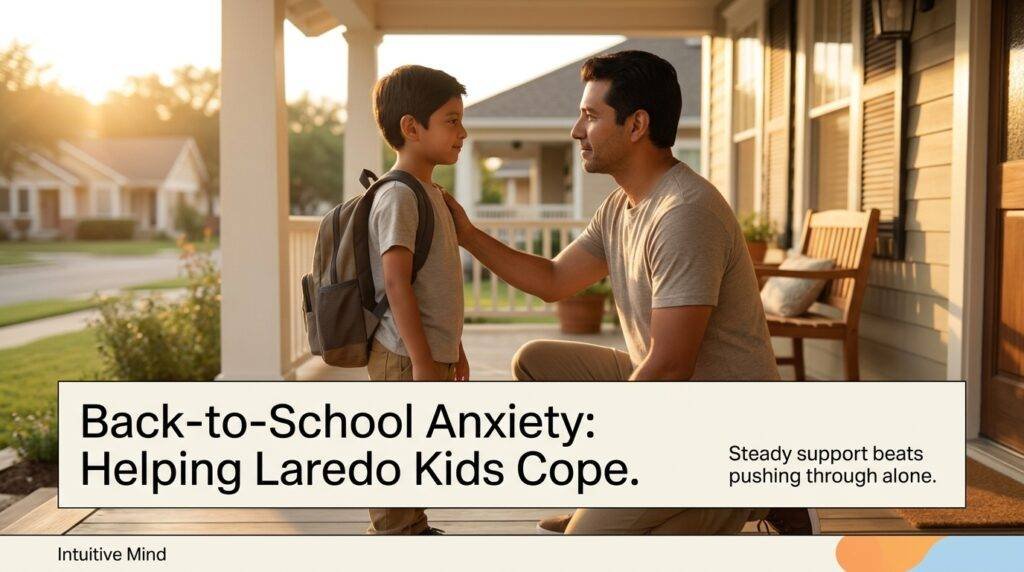
When First-Day Nerves Become Something More
It’s the night before the first day of school in Laredo. The backpack is packed, the uniform is laid out, and your child is in tears. Or they’ve gone quiet in a way that worries you. Or it’s the third night in a row they’ve said their stomach hurts. Most parents expect some jitters. What’s harder to know is when back-to-school anxiety is a passing phase and when it’s a sign your child needs more support.
You may feel stuck between two instincts. One says, “Push through, they’ll be fine once they get there.” The other says, “Something is really wrong, and I don’t want to make it worse.” Both come from love, and neither one, on its own, tells you what your child actually needs.
The weeks around a new school year ask a lot of kids. There are new teachers, new classrooms, new social circles, earlier mornings, and, for many children, a new campus altogether. Some kids adjust within days. Others carry the stress home, and it shows up as sleepless nights, short tempers, or a growing list of reasons to stay home.
For many Laredo families, getting a child seen by a mental health specialist in person can mean a drive to San Antonio, more than two hours each way. That distance is one reason families wait, hoping things settle on their own. Sometimes they do. When they don’t, the delay can make the next school morning harder than the last.
This guide is written for parents and caregivers. It explains what back-to-school worry looks like at different ages, why it’s often missed, what effective care involves, and how to decide when it’s time to talk with a professional. Let’s start with what this kind of anxiety is, and what it isn’t.
Understanding Back-to-School Anxiety in Children
Back-to-school anxiety is the worry, fear, or dread a child feels about returning to school or starting a new one. It usually peaks in the days before school begins and during the first few weeks of the year. For most children, it fades as routines settle in. For some, it lingers, intensifies, or spreads into other parts of life.
Anxiety in children rarely announces itself as “I feel anxious.” It tends to show up in the body and in behavior. Common signs include:
- Stomachaches, headaches, or nausea, especially on school mornings or Sunday nights
- Trouble falling asleep, nightmares, or waking early before school days
- Clinginess, tearful drop-offs, or repeated “what if” questions
- Irritability, meltdowns, or shutting down after school
- Asking to stay home, frequent calls from the school nurse, or refusing to get in the car
- In teens: withdrawing, staying up very late, or refusing to talk about school at all
How it changes with age. Younger children often struggle with separation from a parent and the unfamiliarity of a new classroom. Middle schoolers tend to worry about fitting in, changing classes, and keeping up. Teenagers may feel pressure about grades, friendships, social media, and the future, and they are more likely to hide what they’re feeling.
Life changes add up. A move, a new campus, a family change, or a hard previous year can all make the return to school feel heavier. For children in bilingual homes, the shift from a summer of mostly Spanish at home back to a full day of English instruction can add another layer of effort, especially for younger students.
Nerves, or something more? Ordinary first-week nerves are usually short-lived and don’t stop a child from participating. Anxiety that needs attention tends to last several weeks or longer, feels out of proportion to the situation, and interferes with sleep, learning, friendships, or attendance.
It also helps to look beyond anxiety itself. Trouble focusing in class can come from worry, from ADHD, or from both. A child who suddenly dreads school may be reacting to something real, such as bullying or a difficult classroom situation, which needs to be addressed directly. In teens, persistent sadness or loss of interest alongside worry can point to depression.
Physical complaints deserve to be taken seriously, too. If stomachaches or headaches are new, severe, or come with fever, vomiting, or weight loss, check with your child’s pediatrician first to rule out a medical cause. Only a qualified clinician can diagnose an anxiety disorder. School screenings and online checklists are useful starting points, not answers.
Why Anxiety in Kids Is Often Missed or Undertreated
Most parents who eventually seek help for an anxious child say the signs were there earlier, but they didn’t look like anxiety at the time. That’s understandable. Childhood anxiety is good at disguising itself.
Physical symptoms get treated as physical problems only. A child with recurring stomachaches may see the pediatrician several times, try changes to diet, or take something for nausea. Those steps are reasonable, and ruling out medical causes matters. But if no one asks what’s happening on the mornings the pain shows up, the pattern can go unrecognized for months.
Behavior gets labeled instead of understood. An anxious child may refuse, argue, or melt down. To a busy adult, that can look like defiance or “overreacting.” Discipline alone rarely helps when the behavior is driven by fear, and it can leave a child feeling misunderstood.
Quiet kids fall through the cracks. Some children hold it together all day at school, comply with every rule, and then fall apart the moment they get home. Teachers may see no problem at all. Parents, meanwhile, are seeing the full weight of it every evening.
Families wait it out. Because some nervousness is expected, it’s easy to assume it will pass. Waiting a few weeks is often reasonable. Waiting through a whole semester while things get worse is harder to recover from.
Care is split across too many places. The pediatrician sees the stomachaches. The school counselor sees the nurse visits. A therapist, if there is one, sees the child for an hour a week. Without someone pulling the full picture together, each person sees only part of it.
The American Academy of Child & Adolescent Psychiatry offers family-focused guidance on anxiety and school avoidance, and a consistent theme in that guidance is early, coordinated attention rather than waiting for a crisis.
[CLINICIAN’S NOTE] Two patterns we see often: letting school avoidance become routine, and treating only the symptom. Each extra day at home can bring short-term relief, but avoidance tends to make the next return harder, and missed school can lead to falling behind, which feeds the worry. Similarly, treating stomachaches or sleep problems without asking what’s driving them can leave the anxiety itself untouched. If your child is already missing school regularly, work with a provider and the school on a plan for a gradual return rather than handling it alone.
A Whole-Person Approach to Helping Anxious Kids
Effective care for an anxious child doesn’t start with a prescription or a worksheet. It starts with understanding the whole child: their temperament, their body, their family, their school, and the specific situations that set off their worry. From there, care is built in layers, and the layers work best when they’re connected.
A comprehensive evaluation comes first. A thorough psychiatric evaluation looks at mood, worry, sleep, appetite, development, school performance, friendships, family history, and recent changes. Parents and the child both contribute, in ways that fit the child’s age. With your permission, input from the pediatrician or school can fill in gaps. This is the foundation of our children’s mental health care, because a plan is only as good as the understanding behind it.
Therapy builds skills that last. The National Institute of Mental Health describes cognitive behavioral therapy (CBT) as a well-studied, effective treatment for anxiety. For children, CBT often involves learning to notice anxious thoughts, practicing calming skills, and facing feared situations in small, manageable steps rather than avoiding them. A child who can’t walk into the classroom might start by visiting the campus after hours, then meeting the teacher, then attending part of a day.
Parents are part of the treatment. Kids take cues from the adults around them. Parent guidance helps you know when to comfort, when to encourage, and how to respond to “I can’t go” without either forcing or rescuing. Many parents find this is where the biggest day-to-day change happens. The same principles shape how we approach anxiety and panic treatment for older teens and adults.
Medication is sometimes part of the plan. When anxiety is moderate to severe, or isn’t improving enough with therapy alone, a prescriber may discuss medication with the family. This is always a shared decision. Your child’s prescriber will talk through options, expected benefits, possible side effects, and how progress will be monitored. When medication is being considered, pharmacogenomic testing may offer information about how a child’s genes could affect their response to certain medications, which can help guide choices. It doesn’t guarantee the right medication, but it can add useful information.
The body matters, too. Sleep, nutrition, physical activity, and screen habits all affect how well a child handles stress. In some cases, physical factors such as thyroid problems can mimic or worsen anxiety symptoms, so lab testing may be recommended when the picture suggests it. These steps don’t replace mental health care; they make sure nothing physical is being overlooked.
Look for what else might be going on. Worry and attention problems often overlap, and treating one without recognizing the other can stall progress. If focus, impulsivity, or homework struggles have been an issue for years, an ADHD evaluation may be part of understanding the full picture.
School is part of the team. With your consent, coordinating with teachers and counselors can make a gradual return plan realistic. When appropriate, schools can also put formal supports in place, such as a 504 plan. Care should also respect your family’s language, values, and culture, so that the plan fits the home your child actually lives in.
How progress is measured. Success isn’t measured by a child never feeling nervous again. It looks like smoother mornings, fewer calls from the nurse, better sleep, steadier attendance, more time with friends, and a child who can say, “I was worried, and I did it anyway.”
When a child’s anxiety is treated one symptom at a time, the stomachache gets attention, the sleep problem gets attention, and the fear underneath keeps growing. Whole-person care connects the body, the family, and the school around one shared plan. That connection is often what turns a hard school year into a manageable one.
Comparing Your Care Options
The type of help matters as much as getting help at all. Each option below has real value for some families; the question is which fits your child’s needs right now.
| Care Option | What It Addresses | Often a Good Fit When | Limitations to Know |
|---|---|---|---|
| Self-help and parent resources | Routines, coping skills, parent understanding | Worry is mild, short-lived, and not affecting attendance | Not enough when anxiety persists or interferes with daily life |
| Pediatrician only | Physical health, ruling out medical causes, initial screening | Physical symptoms are new or a first check-in is needed | Short visits; limited time for ongoing mental health treatment |
| School counselor support | Classroom adjustment, check-ins, peer issues | Challenges are mostly school-based and mild to moderate | Limited availability; can’t diagnose or prescribe |
| Therapy only | Coping skills, gradual exposure, emotional support | Anxiety is moderate and the family can commit to regular sessions | May not address medical, attention, or medication questions |
| Medication only | Symptom intensity | Rarely recommended alone for children | Skills and family support are usually needed for lasting change |
| Integrated psychiatric care (Intuitive Mind approach) | Evaluation, therapy, medication when appropriate, physical factors, family and school coordination | Anxiety is persistent, complex, or hasn’t responded to other steps | Requires an evaluation first; plan and pace depend on the individual child |
The CDC identifies anxiety as one of the most commonly diagnosed mental health conditions in children, which means you are far from alone in facing this. It also means there are well-established ways to help.
A practical way to use this table: if your child’s worry is mild and fading, start with routines and parent resources, and check in with the pediatrician about any physical complaints. If it has lasted more than a few weeks, is getting worse, or is causing missed school, it’s reasonable to move to a fuller evaluation.
What to Expect at Intuitive Mind
We see patients by telehealth across Texas, so Laredo families can meet with us from home without the drive north. Our office is in New Braunfels for families who prefer to come in person.
Initial Evaluation. You and your child meet with our provider for a thorough conversation about what’s been happening, when it started, and how it’s affecting home and school. Expect questions about sleep, appetite, friendships, family history, and past treatment. It helps to bring report cards or notes from school, pediatrician records, a list of current medications, and a short list of what you’ve already tried. We handle the assessment and explain our findings in plain language.
Personalized Plan. Together, we build a plan matched to your child’s needs. That may include therapy, parent guidance, lifestyle steps, lab work, or a discussion of medication. You’ll know what each part is for and what to watch for at home. Your role is to share what fits your family and what doesn’t.
Ongoing Care. Follow-up visits track how things are going: mornings, sleep, attendance, mood, and your child’s own sense of progress. You’ll keep sharing what you’re seeing, and we’ll keep refining the plan.
Adjust and Coordinate. As your child changes, the plan changes. With your consent, we coordinate with your child’s pediatrician, school, or therapist so everyone is working toward the same goals. You can read more about our whole-person approach to care.
Every child is different, and the pace of progress varies from one child to the next.
Common Questions About Back-to-School Anxiety
Is it normal for kids to be nervous about going back to school?
Yes. Some nervousness before a new school year is common, especially with a new teacher, grade, or campus. It usually eases within the first few weeks as routines settle. It’s worth a closer look when the worry lasts longer, keeps growing, or starts to affect sleep, eating, friendships, or attendance.
When should I seek help for my child’s anxiety about school?
Consider an evaluation if anxiety lasts more than a few weeks, seems out of proportion to the situation, causes frequent physical complaints, or leads to missed school. Seek help sooner if your child talks about hopelessness or harming themselves. In an emergency, call or text 988 or call 911.
Can my child be seen by telehealth in Laredo?
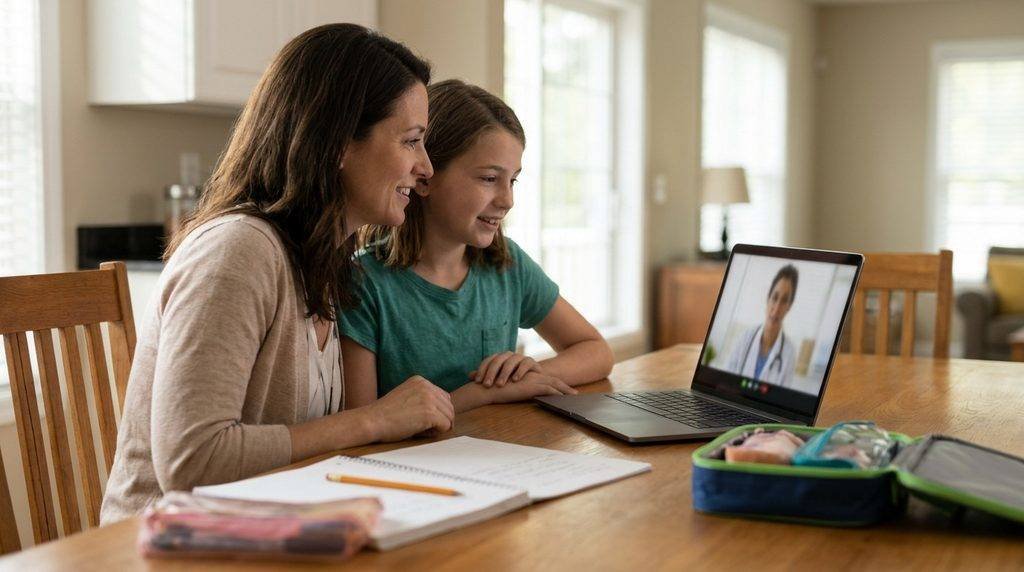
Yes. We provide telehealth care for patients located anywhere in Texas, including Laredo. A parent or guardian takes part in visits for younger children, and the format is adapted to your child’s age. Telehealth can make consistent care easier when the nearest in-person specialist is hours away.
Does insurance cover psychiatric care for children?
We work with many major insurance plans and also offer self-pay. Contact us to confirm coverage. Some plans have specific rules for behavioral health visits or referrals, so it can help to check your plan’s mental health benefits before your first appointment.
Your Next Step Is a Conversation
Back-to-school anxiety is common, and for many kids it fades on its own. When it doesn’t, it isn’t a sign that your child is weak or that you’ve done something wrong. It’s a signal that your child needs more support than encouragement alone can give, and that support works best when someone looks at the whole picture: body, emotions, family, and school.
The most useful next step isn’t guessing or waiting another semester. It’s a comprehensive evaluation that helps you understand what’s really driving your child’s anxiety before deciding what to change.
- Ready to start? Book an evaluation with Intuitive Mind. Telehealth visits are available for families in Laredo and throughout Texas.
- Prefer to talk first? Call us at (830) 302-4097 with your questions.
- Want to learn more? Explore our approach to mental health care for children and teens.
If you or your child is in crisis or thinking about self-harm, you don’t have to wait for an appointment. Call or text 988 to reach the 988 Suicide & Crisis Lifeline, available 24/7. If you or someone else is in immediate danger, call 911 or go to the nearest emergency room. Intuitive Mind is not an emergency service.
About This Article
Written by the Intuitive Mind Behavioral Health Care Team Clinically reviewed by Lydia Kimeli-Pope, MSN, PMHNP
Intuitive Mind Behavioral Health is a psychiatric mental health practice based in New Braunfels, Texas, offering whole-person care for adults, children, and families, in person and through telehealth across Texas and New Mexico. Our approach combines psychiatric evaluation, therapy, medication management, pharmacogenomic testing, functional and hormonal lab testing, and nutritional and lifestyle support.
🌐 intuitive-mind.com 📍 387 W. Mill St. Suite 106, New Braunfels, TX 78130 📞 (830) 302-4097