

The Dangerous Myth of the “Visible” Eating Disorder
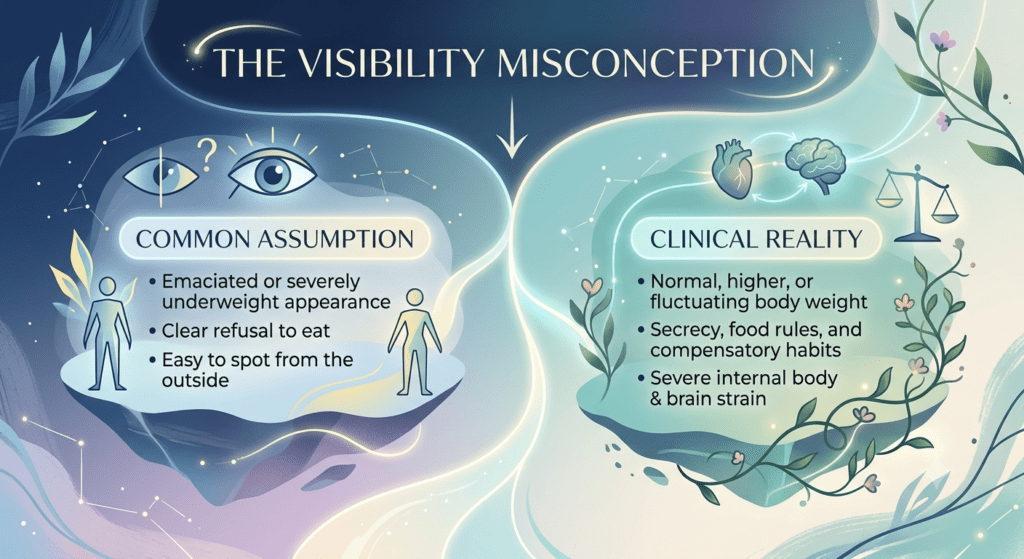
For parents living along Lake Dunlap and across Guadalupe County, watching children grow through adolescence and young adulthood brings both joy and new challenges. When we picture someone living with an eating disorder, popular media often leads us to imagine a severely underweight or emaciated individual.
However, clinical research and real-world experience tell a very different story: the vast majority of people with eating disorders do not look visibly ill.
Conditions such as Atypical Anorexia Nervosa, Bulimia Nervosa, Binge Eating Disorder (BED), and Avoidant/Restrictive Food Intake Disorder (ARFID) frequently affect teens and young adults who appear completely healthy on the outside. Because physical appearance can be deceiving, many parents miss the early warning signs of invisible eating disorders near Lake Dunlap, allowing disordered patterns to quietly take root.
Recognizing the Hidden Signs: Beyond the Scale
When weight remains stable, disordered eating relies on psychological patterns, secretive behaviors, and subtle shifts in daily routines. Parents should look out for a combination of emotional, behavioral, and physical cues.
Behavioral & Emotional Red Flags
- Extreme Rules Around Food: Cutting out entire macro groups, counting calories meticulously, or insisting on preparing meals separately from the family.
- Shifted Mealtime Behaviors: Suddenly leaving the table immediately after eating, hiding food packaging in trash bins, or expressing sudden, extreme anxieties about ingredients.
- Compulsive or Rigid Exercise: Insisting on intense workouts regardless of fatigue, illness, or severe weather—often driven by guilt rather than enjoyment.
- Social Withdrawal: Excusing themselves from family gatherings, lake outings, or dinners with friends specifically to avoid situations centered around food.
- Changes in Style: Wearing oversized, baggy clothing to mask body shape or regulate persistent cold sensitivity caused by metabolic slowdown.

Medical Risks Hidden Beneath the Surface
The physical impact of disordered eating occurs internally long before outward changes show up. Chronic caloric restriction, purging, or bingeing creates significant metabolic strain across the entire body.
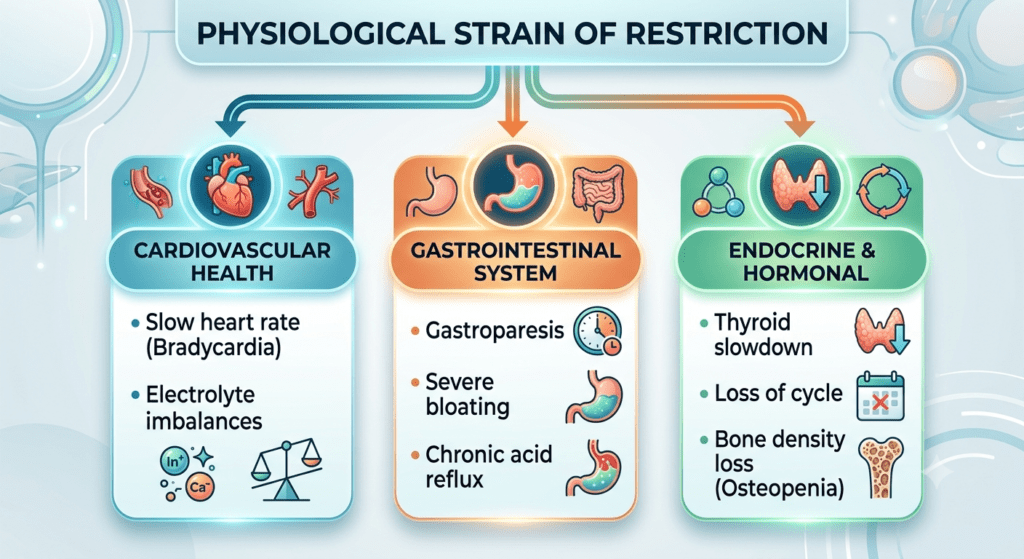
- Cardiovascular Strain: Severe restriction forces the heart muscle to slow down (bradycardia) to conserve energy, increasing the risk of arrhythmias.
- Electrolyte Imbalances: Purging, laxative use, or extreme water drinking can cause dangerous drops in potassium and sodium levels.
- Gastrointestinal Slowdown: Reduced food intake slows down gastric emptying (gastroparesis), causing painful bloating, nausea, and early fullness when trying to eat.
- Hormonal Dysregulation: Hypothalamic amenorrhea (loss of menstrual cycles), thyroid dysfunction, and elevated stress hormones (cortisol) frequently develop.
To understand how eating disorders intersect with co-occurring mood challenges, explore our dedicated services for anxiety care services, depression care, and mood disorder treatment.
Traditional vs. Integrative Psychiatric Care
Standard psychiatric visits often last only 15 minutes and rely heavily on quick symptom checks and immediate prescription writing. While psychiatric medications play an important role, managing complex conditions like eating disorders requires looking at the whole picture—including biology, nutrition, and mental health.
At Intuitive Mind Behavioral Health, located just minutes from Lake Dunlap in New Braunfels, we provide comprehensive, whole-person care.
During our 90-minute initial intake, we evaluate overall physical health, nutritional balance, sleep patterns, and emotional well-being. When medication is beneficial to treat underlying anxiety, depression, or obsessive thoughts, we utilize GeneSight® pharmacogenomic testing to identify medications that align best with your child’s genetic profile, minimizing side effects and avoiding unnecessary trial-and-error.
“Eating disorders thrive in secrecy and isolation. When parents learn to look beyond weight and observe behavioral shifts, early intervention can protect a young person’s health and future.”
— Lydia Kimeli-Pope, MSN, PMHNP-BC

How Parents Near Lake Dunlap Can Take Action
If you notice subtle red flags in your adolescent or young adult child, taking early action is key to their recovery.
| Action Step | What It Looks Like in Daily Life | Why It Matters |
| Shift the Focus Away from Weight | Focus conversations on energy, mood, hobbies, and emotional well-being rather than body size. | Removes the pressure surrounding physical appearance and creates a safer space for open dialogue. |
| Schedule a Comprehensive Assessment | Seek a clinical evaluation that includes medical labs, emotional history, and dietary patterns. | Identifies hidden physiological strain before long-term health complications arise. |
| Maintain Regular Family Mealtimes | Offer relaxed, low-pressure family meals where food is neutral and enjoyment is prioritized. | Reduces mealtime anxiety and models a balanced, comfortable relationship with food. |
| Coordinate Care Teams | Work with a psychiatric provider who collaborates directly with therapists and registered dietitians. | Delivers a unified treatment strategy that supports both mind and body. |
Learn more about our practice philosophy on our about page and review our approach to complex conditions like bipolar disorder care.
“You don’t need to wait for a severe physical crisis to validate your intuition. If something feels off with your child’s relationship with food or energy, reaching out for guidance is the right step.”
— Lydia Kimeli-Pope, MSN, PMHNP-BC
If your family is dealing with a severe emotional or mental health crisis, immediate support is always available. Contact the 988 Suicide & Crisis Lifeline by calling or texting 988 for free, confidential, 24/7 support.
For additional educational resources on eating disorder recognition and recovery, visit the National Eating Disorders Association (NEDA) or the Substance Abuse and Mental Health Services Administration.
Why Guadalupe County Families Turn to Intuitive Mind
Intuitive Mind Behavioral Health is led by Lydia Kimeli-Pope, MSN, PMHNP-BC—a Board-Certified Psychiatric Mental Health Nurse Practitioner dedicated to serving children, adolescents, young adults, and women.
Conveniently located in New Braunfels, TX, our clinic offers accessible in-person visits for families across Lake Dunlap, Seguin, and San Marcos, as well as virtual telehealth options statewide. Discover details on our contact page.
Step-by-Step Pathway to Care
Getting your child or loved one connected with supportive care is clear, straightforward, and collaborative.
![An informational infographic titled "YOUR CARE JOURNEY," set in a sunlit room featuring multi-paned windows, potted houseplants, and two armchairs with coffee cups. The design uses a color scheme of sage green, brown, cream, and terracotta, outlining a three-step medical care pathway connected by sequential green arrows. Step 1 (Left Panel): Titled "[Step 1: Free Consult] • 15-min phone call," showing illustrations of a hand holding a smartphone, speech bubbles, calendars, and a telephone receiver. A bullet point at the bottom reads: "Never stop, start, or adjust medications without direct supervision from a qualified healthcare provider." Step 2 (Center Panel): Titled "[Step 2: 90-Min Intake] • Deep-dive assessment," containing anatomical diagrams, hormone level charts for estrogen and progesterone, and an illustration of a medical team labeled "Review" and "Comprehensive Physiological Mapping." A text block below notes: "In-depth review of medical history, current symptoms, and full physical-mental evaluation." Step 3 (Right Panel): Titled "[Step 3: Plan] • Labs & care path," showing illustrations of a microscope, medical report documents, a petri dish, a calendar labeled "Personalized Action Plan," and a "Healthy Food Plate" diagram. The description below reads: "Custom integration of lab test results, functional genetic analysis, personalized lifestyle routines, and refined medication options." Bottom Elements: The lower section includes interconnected feedback arrows, a DNA strand, a prescription bottle, an hourglass, an atom, and a central handshake icon beneath a diverse group of people. Text blocks read "A path to clarity and evidence-based decisions" and "Integrating functional lab assessments and genetic factors," anchored at the bottom center by the title "PERSONALIZED RECOVERY PATH."](https://intuitive-mind.com/wp-content/uploads/2026/07/Gemini_Generated_Image_ddqy5dddqy5dddqy-1024x559.png)
- Free 15-Minute Consultation: A brief phone call to share your concerns and confirm if our integrative approach is right for your family.
- Pre-Appointment Intake Forms: Easily submit medical, developmental, and emotional history online prior to your visit.
- 90-Minute Comprehensive Intake: An unhurried session (in-person or virtual) exploring physical health, lifestyle factors, coping mechanisms, and history.
- Targeted Lab Work: Ordering functional blood panels or GeneSight® testing as clinically appropriate.
- Personalized Care Plan: Developing a treatment strategy that aligns medical management, nutritional therapy, and therapy support.
Reach Out for Compassionate Guidance Today
You do not have to navigate concerns about your child’s health alone. Gentle, expert guidance is available right here in your community.
Take the first step toward clarity and healing today:
- Primary Step: Book a Free 15-Minute Consult
- Direct Phone: Call us directly at (830) 302-4097
- Learn More: Explore details on our anxiety care services
We are honored to serve families in Lake Dunlap, New Braunfels, Guadalupe County, and across Texas. Your child deserves compassionate, whole-person care that sees beyond the surface.
This content is educational and does not replace a formal medical or psychiatric evaluation. Every young person’s situation is unique — use this guide to inform your conversation with a qualified healthcare provider.
About the Author
Intuitive Mind Behavioral Health — Lydia Kimeli-Pope, MSN, PMHNP-BC
Board-Certified Psychiatric Mental Health Nurse Practitioner
Intuitive Mind Behavioral Health is an integrative psychiatric practice based in New Braunfels, Texas, serving children, adolescents, young adults, and women across Lake Dunlap, Seguin, San Antonio, and Austin, with telehealth available across Texas and New Mexico. We combine evidence-based psychiatric care with functional lab testing, nutritional wellness, and pharmacogenomic-guided medication management.
📞 (830) 302-4097
📍 387 W. Mill St. Suite 106, New Braunfels, TX 78130
Accepting new patients. Free 15-minute consultations available.