

Is It Too Late for an Adult ADHD Diagnosis?
If you live in Canyon Lake or surrounding Comal County, managing a busy home, career, and personal life requires steady executive functioning. Yet, for many adults, daily life feels like an endless marathon of keeping up with shifting priorities, misplaced keys, forgotten obligations, and a mind that never seems to quiet down.
Perhaps you spent decades assuming you were simply “lazy,” “disorganized,” or “bad at managing stress.” You may have tried endless planners, productivity apps, or traditional therapies, only to feel demoralized when the same patterns returned.
The short answer is no, it is never too late to be diagnosed with ADHD as an adult.
Whether you are 28, 42, or 65, receiving an accurate adult ADHD diagnosis in Canyon Lake opens the door to self-compassion, targeted neurobiological treatments, and practical tools that can transform your daily quality of life.
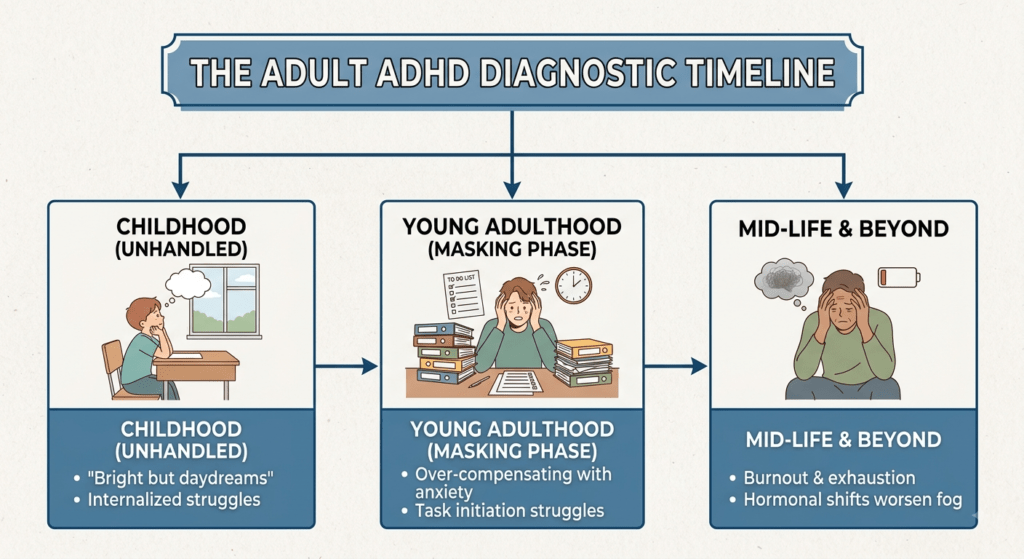
How Adult ADHD Actually Presents
While childhood ADHD is often stereotyped as a student unable to sit still in class, adult ADHD presents quite differently. As responsibilities compound, executive functioning demands outpace the brain’s natural coping mechanisms.
Common Signs of Unrecognized Adult ADHD
- Chronic Procrastination & Task Paralysis: Staring at an important work project or household chore for hours, unable to take the first step despite urgent deadlines.
- Time Blindness: Consistently underestimating how long tasks take, leading to chronic lateness, rushed mornings, or missed appointments.
- Internal Restlessness & Racing Thoughts: Feeling physically still on the outside while your mind runs through dozens of disconnected thoughts simultaneously.
- Emotional Dysregulation: Experiencing sudden bursts of frustration, intense sensitivity to perceived rejection, or feeling easily overwhelmed by minor disruptions.
- Hyperfocus Cycles: Spending hours deeply engrossed in a compelling passion project while completely ignoring basic needs like eating, resting, or attending to urgent responsibilities.
- Disorganization & Lost Items: Constantly misplacing essential items (keys, phone, wallet, documents) and struggling to maintain clutter-free spaces at home or work.
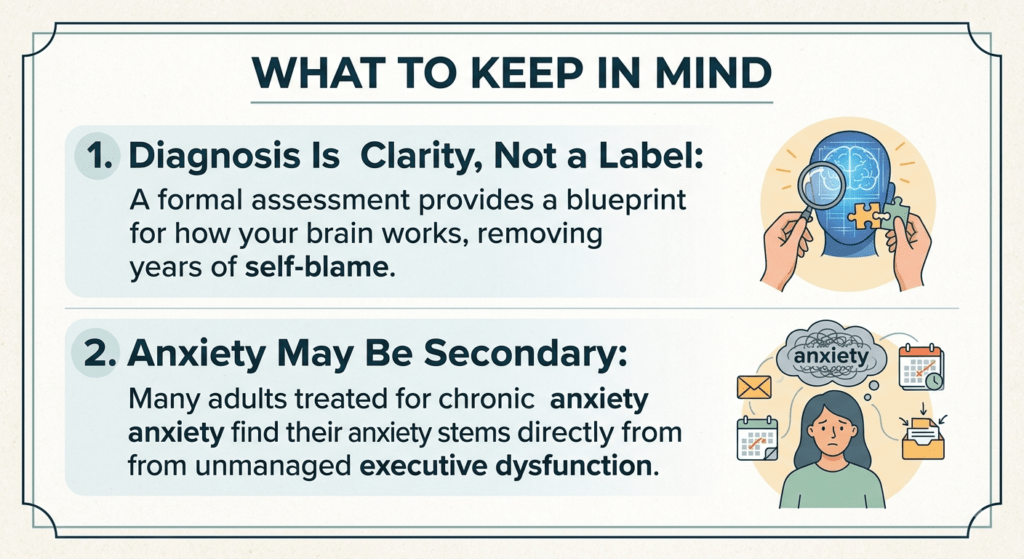
The Neurobiology of Adult ADHD and Executive Function
ADHD is a neurodevelopmental condition characterized by dysregulation of key neurotransmitters—primarily dopamine and norepinephrine. These brain chemicals regulate interest, reward processing, sustained focus, and working memory.
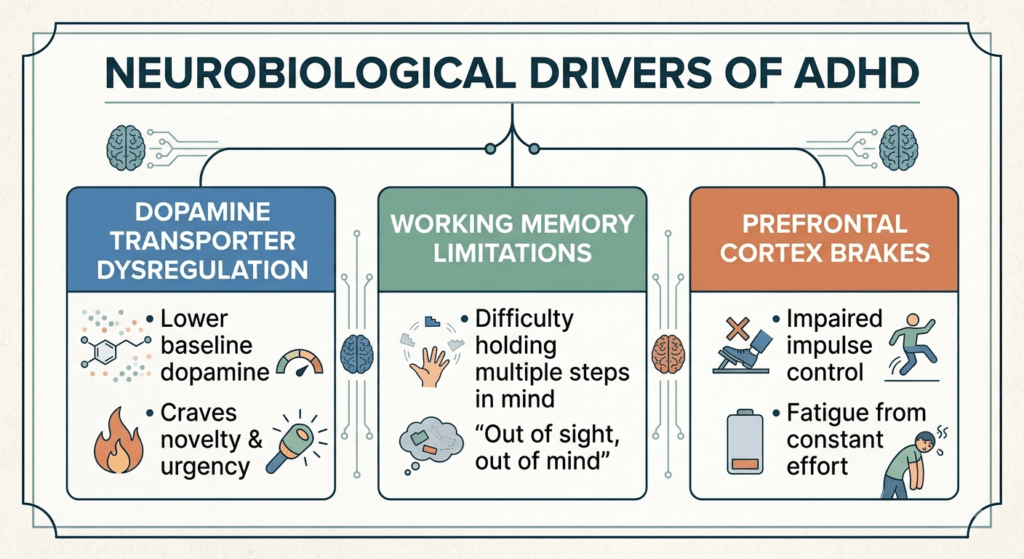
When dopamine availability is inconsistent, the prefrontal cortex—the brain’s command center—must exert double the effort to maintain attention on routine tasks. Over time, this constant cognitive overexertion leads to deep mental fatigue, chronic burnout, and secondary mood challenges.
To explore how ADHD intersects with other emotional health concerns, read our dedicated pages on mood disorder treatment, anxiety care services, and depression care.
Traditional vs. Integrative ADHD Evaluations
Standard clinical assessments for adult ADHD often consist of a hurried 15-minute intake and a quick checklist. This superficial approach can lead to misdiagnosis—either prescribing stimulant medications without investigating underlying physical health, or dismissing symptoms entirely as “just stress.”
At Intuitive Mind Behavioral Health, located convenient to Canyon Lake in New Braunfels, we take a thorough, respectful, and whole-person approach to adult diagnostic care.
During our 90-minute initial evaluation, we take the time to hear your full life story. We rule out contributing physical factors such as thyroid imbalances, sleep apnea, or vitamin deficiencies that mimic cognitive impairment.
When medication management is appropriate, we utilize GeneSight® pharmacogenomic testing to determine how your body metabolizes specific medications, minimizing trial-and-error side effects and optimizing focus.
“An adult ADHD diagnosis is not about making excuses for past struggles—it is about providing the neurobiological tools and validation needed to build a thriving future.”
— Lydia Kimeli-Pope, MSN, PMHNP-BC
Practical Daily Strategies for Canyon Lake Adults
While formal treatment provides core neurochemical balance, incorporating targeted executive-function strategies can streamline daily living.
| Strategy | Action Step | How It Helps the ADHD Brain |
| Externalize Working Memory | Use visual whiteboards, digital timers, or sticky notes instead of relying on mental mental lists. | Reduces cognitive load on a overworked prefrontal cortex. |
| Body Doubling & Workspace Design | Work alongside a partner or in a community space like a quiet library. | Increases baseline dopamine and accountability through gentle social presence. |
| Micro-Stepping (The 5-Minute Rule) | Break daunting tasks down into the smallest possible starting step. | Overcomes task initiation paralysis by lowering the brain’s perceived barrier. |
| Optimize Sleep & Movement | Engage in daily morning sunlight exposure and moderate physical activity. | Boosts natural dopamine and norepinephrine production to enhance daytime focus. |
Learn more about our philosophy on our about page and discover how we support families through child and adolescent psychiatry.
“When you understand how your brain works, you stop fighting against your nature and start building systems that honor your strengths.”
— Lydia Kimeli-Pope, MSN, PMHNP-BC
If you or a loved one are experiencing an emotional crisis, help is always accessible. Contact the 988 Suicide & Crisis Lifeline by calling or texting 988 for free, confidential, 24/7 assistance.
For additional adult ADHD education and research, visit CHADD (Children and Adults with Attention-Deficit/Hyperactivity Disorder) or the National Institute of Mental Health (NIMH).
Why Canyon Lake & Comal County Adults Choose Intuitive Mind
Intuitive Mind Behavioral Health is led by Lydia Kimeli-Pope, MSN, PMHNP-BC—a Board-Certified Psychiatric Mental Health Nurse Practitioner dedicated to compassionate, personalized care.
Located close to Canyon Lake, Startzville, Sattler, and Fischer, our New Braunfels office provides a welcoming environment for in-person evaluations, alongside convenient telehealth options across Texas. Reach out through our contact page.
Step-by-Step Pathway to Care
Embarking on your diagnostic journey is simple, respectful, and structured to give you clarity every step of the way.
- Free 15-Minute Consultation: A confidential brief phone call to discuss your concerns and determine if our practice is the right fit.
- Pre-Appointment Intake: Complete comprehensive background forms online at your own pace before your appointment.
- 90-Minute Initial Intake: An unhurried session evaluating developmental history, current executive struggles, physical health, and personal goals.
- Targeted Testing & Labs: Functional blood work or GeneSight® testing as clinically recommended.
- Personalized Care Plan: Crafting a tailored support system combining executive function coaching, lifestyle modifications, therapy alignment, and precision medication management.
Take the First Step Toward Clarity Today
You do not have to continue struggling through daily tasks in frustration. Understanding your brain is the first step toward lasting peace of mind.
Connect with our care team today:
- Primary Step: Book a Free 15-Minute Consult
- Direct Phone: Call us directly at (830) 302-4097
- Learn More: Explore details on our mood disorder treatment
We proudly serve adults and families in Canyon Lake, New Braunfels, Spring Branch, Bulverde, and across Texas. Let us help you gain the clarity, validation, and support you deserve.
This content is educational and does not substitute for a formal clinical evaluation. Every individual’s neurodevelopmental journey is unique—use this guide to inform your conversation with a licensed healthcare provider.
About the Author
Intuitive Mind Behavioral Health — Lydia Kimeli-Pope, MSN, PMHNP-BC
Board-Certified Psychiatric Mental Health Nurse Practitioner
Intuitive Mind Behavioral Health is an integrative psychiatric practice located in New Braunfels, Texas, serving adults, young adults, and children across Canyon Lake, Comal County, San Antonio, and Austin, with telehealth available across Texas and New Mexico. We combine evidence-based psychiatric care with functional lab testing, nutritional wellness, and pharmacogenomic-guided medication management.
📍 387 W. Mill St. Suite 106, New Braunfels, TX 78130
Accepting new patients. Free 15-minute consultations available.